
The first proposal I ever sent was for a SaaS content project. Six pages. Custom cover page. The client wrote back one line: “Looks great, but what exactly am I paying for?”
That taught me what proposals are for. Not impressing anyone. Making it easy for a skeptical, busy person to say yes. Every vague deliverable is a reason to keep shopping.
Since then I’ve written proposals for six-figure consulting deals, $500 freelance gigs, internal budget requests, and partnership agreements. I co-founded Squibler and Technical Writer HQ, where proposal writing is one of our core topics. I’ve also been on the other side, evaluating proposals from agencies and developers when I was the one writing the check.
Each section below includes actual example text and the structural decisions that make the format work. If you’re new to proposal writing as a discipline, start there for the fundamentals before diving into these examples.
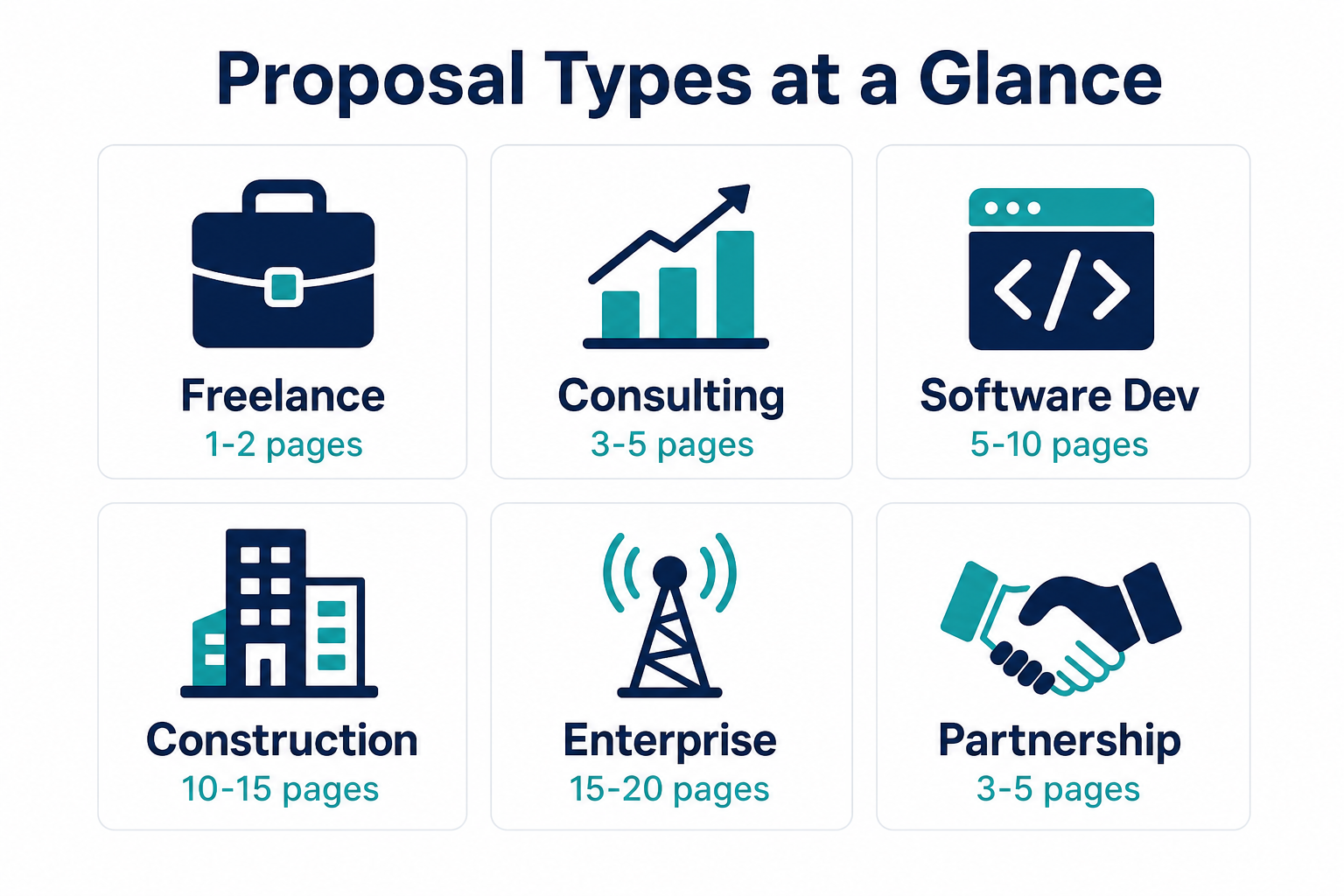
Quick reference: proposal length by type
This is the baseline. When a client says “send a proposal” and gives you almost nothing to work with, this format covers it: what you’re doing, how, what it costs, and what happens next.
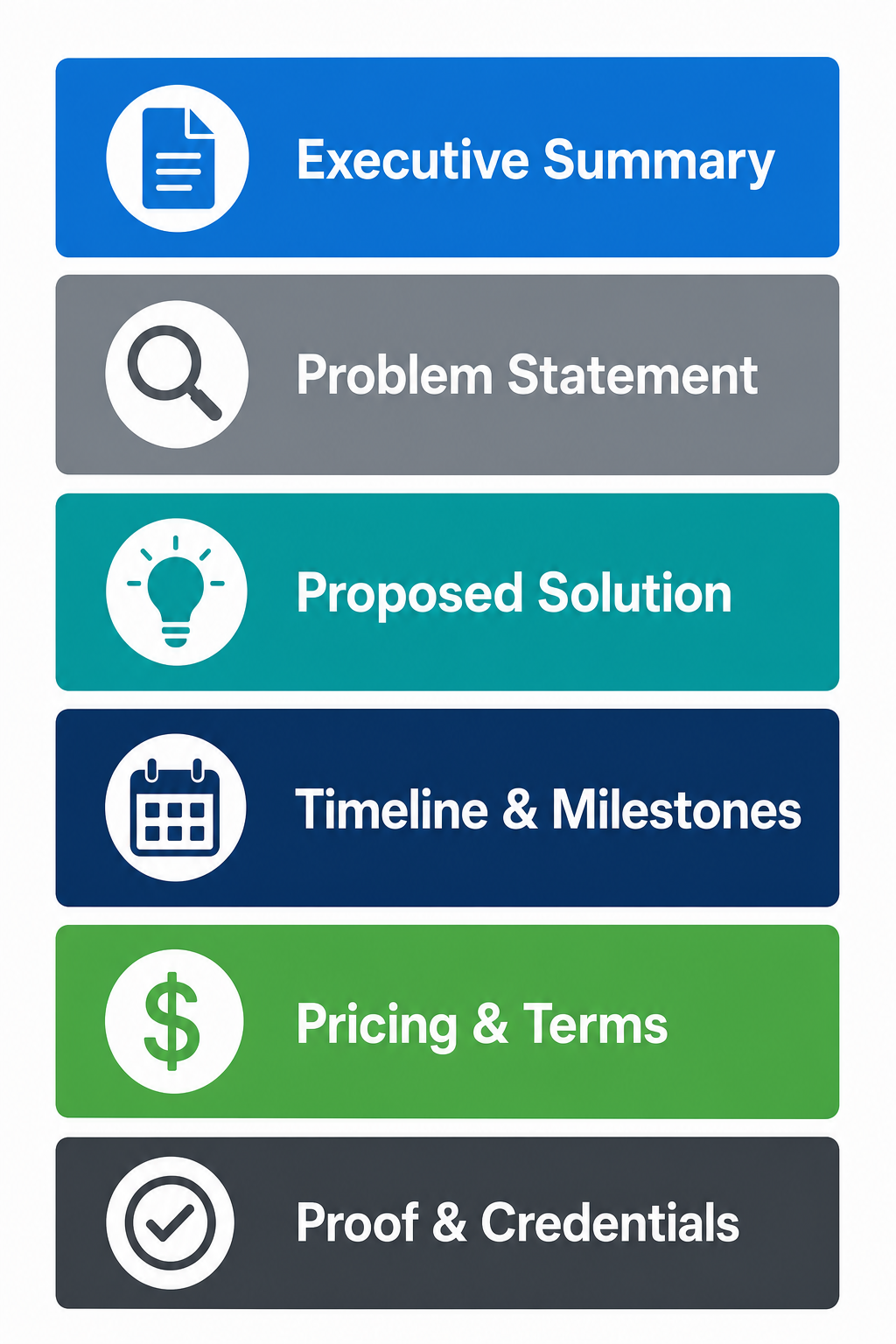
The six sections every general proposal needs
The executive summary decides whether the rest gets read. Here’s one from a SaaS consulting engagement (details changed):
Northline Software is experiencing a 68% drop-off between free trial signup and first meaningful product action. Based on our initial audit, the root causes are a 14-step onboarding flow, no contextual guidance, and a generic welcome email sequence that doesn’t segment by use case.
We propose a 6-week engagement to redesign the onboarding experience across three phases: behavioral audit (weeks 1-2), prototype and user testing (weeks 3-4), and implementation with A/B validation (weeks 5-6).
Expected outcome: reduce onboarding time from 14 days to under 5, targeting a 20-25% improvement in trial-to-paid conversion. Investment: $38,500, with 40% at kickoff and 60% at launch.
The client’s problem is stated with a number (68% drop-off). The plan is three phases with dates. The outcome is measurable. The price is tied to the outcome. That’s the formula.
The most common mistake: leading with an “About Us” section. If your first page is company history and team bios, the reader has to work to understand why the proposal exists. Lead with their problem. They can learn about you on page 3. I cover the full step-by-step in how to write a proposal.
Marketing proposals attract fluff. Everyone promises “growth” and “visibility” without specifying what either means. The ones that win feel like a plan you could start executing Monday morning.
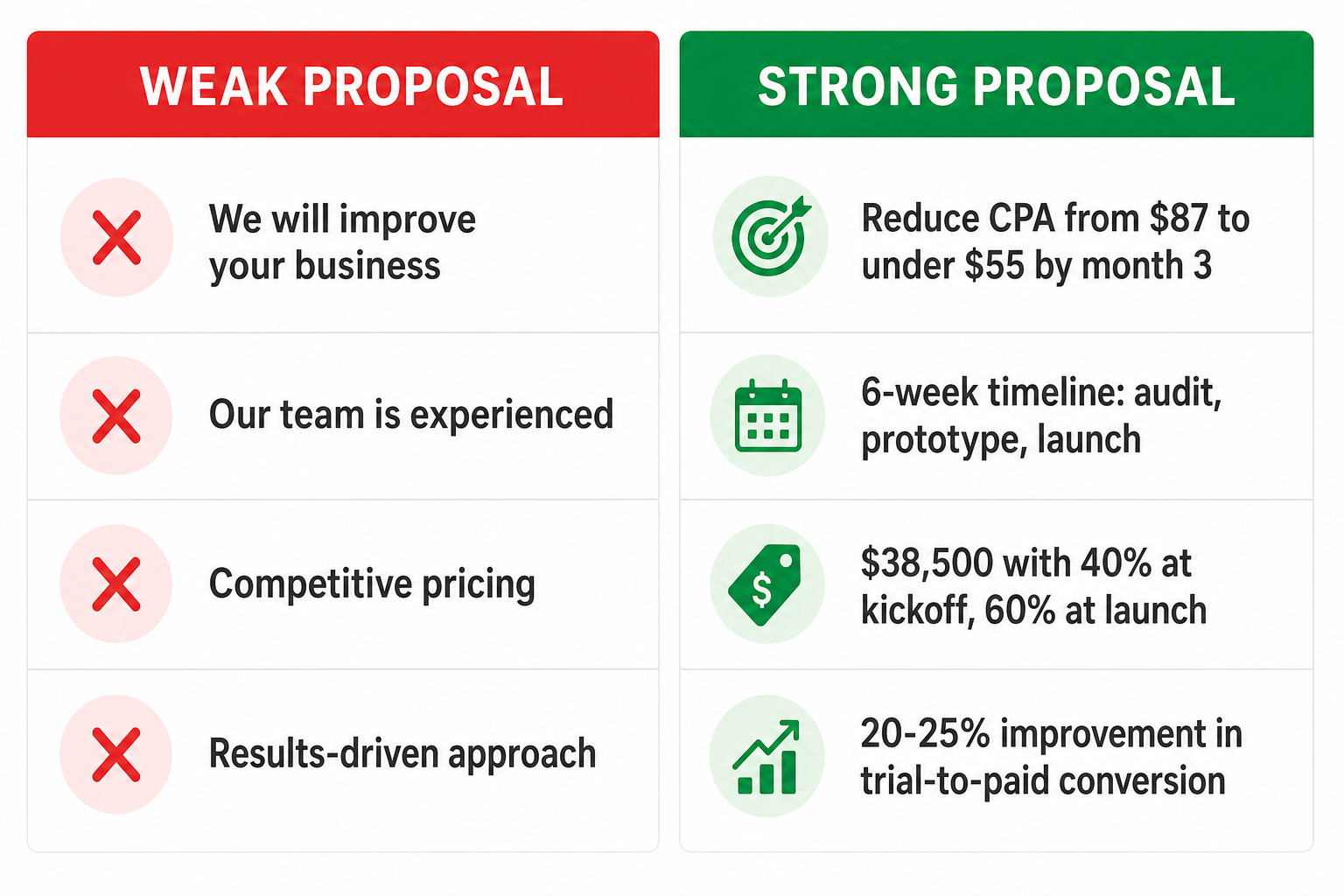
Vague promises vs. specific commitments
Three sections separate winners from filler:
Audit summary. Before pitching solutions, show you understand the current state. One paragraph: “Your Google Ads account runs 14 campaigns with an average CPA of $87, but 60% of spend goes to three campaigns with CPAs above $120. Two campaigns with CPAs under $40 are budget-capped.”
Prioritized roadmap. Not everything you could do. A sequenced plan. Month 1: audit and restructure the ad account. Month 2: launch three test campaigns. Month 3: scale winners, cut losers.
Measurement plan. A table of KPIs with targets and reporting cadence:
Cost Per Acquisition (target: under $55 by month 3)
Return on Ad Spend (target: 3.2x by month 4)
Qualified Lead Volume (target: 180/month, up from 95)
Landing Page Conversion Rate (target: 4.5%, currently 2.1%)
Reports delivered every Monday by 10am via shared dashboard.
That table does more than three pages of marketing philosophy. The client sees you have a system and can hold you to real numbers.
Web design proposals should read like a project plan, not a portfolio dump. The client doesn’t need 40 screenshots of past work in the proposal. They need to know what you’ll build, what you need from them, and how you’ll avoid the rework that turns a 6-week project into a 6-month one.
Scope specificity is everything. One agency structured their deliverables like this:
1 homepage design (desktop + mobile)
5 interior page templates (About, Services, Blog Index, Blog Post, Contact)
1 custom WordPress theme, built on Elementor
Integration: HubSpot form embed on Contact and Services pages
Accessibility: WCAG 2.1 AA compliance on all pages
Content: Client provides all copy. We provide placeholder structure and image sizing specs.
NOT included: copywriting, photography, video production, ongoing maintenance
The “NOT included” line prevents the conversation where the client assumes copywriting is part of the deal. Define the boundary upfront and negotiations become scope adjustments instead of arguments about unmet expectations.
Engineering proposals win on credibility and constraints. The strongest ones make standards, safety requirements, testing gates, and sign-off authority visible from page one. References to specific codes (like AISC standards or ACI specifications) tell the reader you know their regulatory world.
All structural calculations will be performed in accordance with AISC 360-22 and ACI 318-19. Independent peer review will be conducted at 60% and 90% completion milestones. Final deliverables include stamped drawings, a structural calculation package, and a compliance memo referencing applicable IBC 2021 provisions.
Dense, but every word matters to the reader. Engineers know vague scope leads to scope creep, and scope creep in engineering means liability.
The “why us” section works differently here too. Instead of generic claims, good engineering proposals tie experience to the exact problem: “We completed structural analysis for three similar precast parking structures in the last 18 months, including a 450-space facility for Montgomery County.” That’s checkable.
Software proposals fail when they describe features instead of outcomes. A client doesn’t buy “a React frontend with PostgreSQL backend and Redis caching.” They buy “a customer portal that reduces support tickets by 40%.”
One SaaS agency structured a dashboard project this way:
Phase 1: Discovery & Architecture (Weeks 1-2). Stakeholder interviews, data model design, API specification document. Deliverable: Technical Design Document for client approval before any code is written.
Phase 2: Core Build (Weeks 3-6). Sprint 1: Authentication, role-based access, dashboard skeleton. Sprint 2: Data visualization, real-time sync. Sprint 3: Reporting module, export functionality. Demo after each sprint. Client feedback incorporated before next sprint starts.
Phase 3: QA, Security Audit & Launch (Weeks 7-8). Automated test coverage (target: 80%), penetration testing by third-party firm, staged rollout to 10% of users before full launch.
The part worth stealing is their change management clause:
Feature requests after Technical Design approval will be evaluated for scope impact. Changes under 8 development hours are included. Larger changes trigger a mini-proposal with revised timeline and cost.
Every software project changes mid-stream. Handling it upfront, with a clear threshold, avoids the nasty conversations later.
I also look for a risks section. It sounds counterintuitive to list what could go wrong in a sales document, but it works: “Risk: Third-party API rate limits may require caching layer. Mitigation: We’ve budgeted 16 hours for API optimization in the sprint plan.” That tells the client you’ve built this kind of thing before.
IT consulting proposals usually have two readers: a technical lead who wants architecture details and a budget holder who wants clarity. The solution is separating “what” from “how.”
The “what” in plain English: “Migrate your customer database from the legacy on-premise SQL Server to a managed cloud PostgreSQL instance with zero downtime.”
The “how” in the technical plan, specific enough for the engineer but scannable for the CFO.
Include a transition plan. If you’re replacing systems or migrating data, the transition is where projects fail. A table showing “Week 1: Parallel run. Week 2: Validation. Week 3: Cutover. Week 4: Monitoring” gives the client control over the riskiest part. If you’re building a career in this space, the proposal writer career path guide covers how technical consulting fits in.
Keep it short. One to two pages. The client already knows they need a writer. They want to see you understand their topic, you have a process, and your terms are clear.
Here’s the full text of a freelance proposal that won a $4,200/month content retainer:
Hi Sarah,
Thanks for the call on Tuesday. Based on our conversation, here’s what I’m proposing:
Scope: 8 blog posts per month (1,500-2,000 words each), targeting the long-tail SEO keywords we discussed. I’ll handle keyword research, outlines, drafts, and one round of revisions per post.
Process: I’ll send outlines for approval before drafting. Turnaround is 5 business days per post after outline approval. All content delivered in Google Docs with suggested Yoast metadata.
Sample topics based on your keyword gaps:
1. How to Choose a Project Management Tool for Remote Teams
2. Agile vs Waterfall: Which Framework Fits Your Workflow
3. 9 Daily Standup Mistakes That Waste Your Team’s TimeInvestment: $4,200/month. Invoiced on the 1st, net-15. Additional posts beyond 8 are $475 each.
Next step: If this looks right, I can start outlines for the first four posts by Monday.
No company history. No methodology section. The sample topics show the client you already understand their content gaps. That’s more convincing than a paragraph about your qualifications.
One thing to define explicitly: revision limits. “Unlimited revisions” is a trap. State what a revision is, how many are included, and what counts as a scope change.
Construction proposals teach something the other formats don’t: writing with operational reality in mind. Strong bids define scope, schedule, payment milestones, warranty terms, and site condition assumptions. They also state exclusions, because exclusions reduce disputes, and disputes in construction get expensive. The SBA’s business plan guide covers some of the financial planning fundamentals that apply here too.
Payment milestone structure from a general contractor:
10% at contract signing
20% at foundation completion (est. week 3)
25% at framing and rough-in completion (est. week 7)
25% at interior finish and systems test (est. week 11)
20% at final inspection and certificate of occupancy
Tying payments to completion milestones instead of calendar dates protects both sides. The contractor doesn’t work unpaid if inspections are delayed. The client doesn’t pay for unverified work. I borrow this milestone approach for software and consulting proposals too.
A consulting proposal needs to show thinking, not credentials. The client isn’t hiring your resume. They’re hiring your ability to diagnose a problem and build a path from where they are to where they need to be.
Diagnosis-bridge-destination, applied:
Current State: Your sales team is closing 12% of qualified opportunities, down from 18% six months ago. Win/loss interviews suggest the main issues are inconsistent demo quality and a 9-day average response time on technical questions during the evaluation phase.
Target State: Close rate at or above 18%, with demo quality standardized and technical response time under 24 hours.
Bridge Plan: Phase 1 (2 weeks) – Audit current sales process, interview 10 reps. Phase 2 (3 weeks) – Build demo playbook, create technical FAQ resource, design escalation workflow. Phase 3 (3 weeks) – Train team, run coached demos, measure close rate over 30-day window.
“Improve your sales process” is vague. “Move close rate from 12% to 18% by fixing demo quality and response time” is a plan the client can evaluate. For more on how business writing applies across consulting, proposals, and internal communication, we have a full primer.
Define deliverables precisely: logo system (primary, secondary, icon), brand guidelines document (colors, typography, usage rules), file handoff formats (SVG, PNG, PDF). Vague scope in design work leads to endless revision cycles.
From a brand identity proposal:
You’ll receive design concepts as a shared Figma file. Each round includes 3 business days for your team to consolidate feedback into a single document. We strongly recommend appointing one decision-maker to avoid conflicting direction. Two revision rounds are included. Additional rounds are $850 each.
That feedback process is a selling point disguised as logistics. It tells the client you’ve managed design projects before and know how to prevent the too-many-cooks problem.
CRM projects touch data, workflows, team adoption, and reporting simultaneously. They need five sections: discovery and requirements, data migration plan, customization scope, training schedule, and post-launch support window. Miss any of those and the project stalls.
The section that separates good CRM proposals from average ones is the adoption plan. A CRM nobody uses is a waste of money, and the client already knows that. Include specifics: “Weeks 8-10: Onboarding sessions for each department. Week 12: Usage audit, flag low-adoption users. Week 14: Follow-up training for flagged users.” That addresses the real risk, which is never technical. It’s people not using the thing.
In regulated industries, proposals get evaluated through a risk lens. Compliance and confidentiality need to be visible even if the client doesn’t ask. Referencing specific frameworks like SOC 2 Type II tells the reader you operate in their world, not just adjacent to it.
All work will be performed in accordance with SOC 2 Type II controls. Client data will be stored in encrypted, access-controlled environments. No data will be shared with third parties without written authorization.
Pair it with process checkpoints: “Review at week two, review at week four, final sign-off at week six.” The client gets a sense of control over an engagement where they’re trusting you with sensitive operations.
Sales proposals can be long, but the best ones are scannable. Value proposition first, proof second, price third. If a decision-maker can’t find your pricing within 60 seconds, you’ve buried it.
The section that closes deals is a relevant case study:
DataBridge Analytics
Challenge: 340 enterprise accounts, 3 account managers, no systematic expansion playbook. Renewal rate: 74%.What we did: Built an account health scoring model, trained AMs on expansion signals, implemented a quarterly business review template.
Result: Renewal rate increased to 91% within 6 months. Net revenue retention hit 118%, adding $1.2M in expansion revenue from existing accounts.
Specific numbers matching the prospect’s likely situation. “We helped companies grow” is forgettable. “We moved renewal rate from 74% to 91% and added $1.2M” is a reason to take the next call.
Social media proposals need forced specificity or they turn into promises about “brand awareness” and “engagement.” Define: platforms, content types, posting cadence, creative workflow, approval process, how performance gets measured.
Show the content system:
Monday: Content calendar submitted for week-ahead approval (8 posts)
Tuesday: Client feedback due by 5pm
Wednesday-Thursday: Creative production and scheduling
Friday: Performance review of prior week, adjustments to next week’s plan
Also define what’s not included. Social media work expands into “can you also do our email newsletter and landing pages?” without boundaries. Set them in the proposal and scope creep becomes a new-project conversation instead of an argument.
Internal proposals are underrated. If you can get leadership to approve budget with a written proposal, you can get clients to sign contracts. The skills transfer directly.
The structure is simpler. You still need to make ROI obvious:
Problem: The support team manually processes 180 refund requests per week, averaging 12 minutes each. That’s 36 hours of support time per week on a process that could be automated.
Proposed Solution: Build an automated refund workflow using our existing Stripe API and Zendesk integration. Eligible refunds (under $50, within 30-day window, first refund for the customer) are processed automatically. Exceptions flagged for manual review.
Cost: ~80 engineering hours ($12,000 at fully loaded rate). Timeline: 3 weeks.
Projected Savings: 30+ support hours/week reclaimed. At current support team cost, approximately $78,000/year. Payback period: under 8 weeks.
The payback period is what makes leadership say yes. Not elegant engineering. Whether the investment pays for itself, and how fast.
You’re not selling a service here. You’re selling a shared upside. The proposal needs to make the other party’s benefit at least as visible as yours.
Four sections matter: shared goals, who does what, how success gets measured, what happens if it doesn’t work. Partnerships fall apart when roles are vague, especially around marketing, lead ownership, and operational workload.
Include a review cadence: “Monthly check-in with a shared metrics dashboard. Quarterly strategic review to decide whether to expand, continue, or wind down.” The wind-down clause sounds pessimistic. It actually makes partners more comfortable because they know they’re not trapped.
Renewal proposals prove value and make the next phase feel obvious. Use a “what changed” framework:
Year 1 Results:
Organic traffic: 24,000/month to 67,000/month (+179%)
Published: 48 articles, 12 landing pages
Keywords in top 10: 89 to 340
Estimated pipeline contribution: $420,000 in attributed leadsYear 2 Proposal:
Scale content production from 4 to 6 posts/month
Add video content for top 10 performing pages
Launch link building campaign targeting 15 high-DA sites/month
Target: 120,000 organic sessions/month by December
Results do the selling. The expansion section shows the next step. If the trajectory is visible, the renewal conversation becomes “how much more” instead of “whether to continue.”
Don’t pretend nothing went wrong. If three articles underperformed, say so, explain why, and show the adjustment. That honesty keeps the relationship going into year three.
They lead with the client’s problem, not the writer’s credentials.
They make scope visible. Every deliverable defined. Every exclusion stated.
They use numbers. “Improve performance” means nothing. “Reduce onboarding time from 14 days to 5” is something someone can evaluate.
They anticipate objections. Risks section, change management process, exclusions list. Proof you’ve done this before.
They make the next step easy. Not “let us know your thoughts.” Something like “I’ll send a contract by Friday and we can kick off on the 15th.”
If you want structured practice, the proposal writing curriculum at TWHQ covers each of these principles with exercises. And if you’d rather hire a proposal writer instead of doing it yourself, we’ve reviewed the best platforms for that too.

Frequently asked questions about business proposal writing.
Executive summary, problem statement, proposed solution, timeline, pricing, and proof of credibility. The executive summary matters most because it determines whether the rest gets read. If you can answer “what are we doing, when, for how much, and why us” in one page, you have a strong foundation.
Depends on context. A freelance proposal might be one page. An enterprise software build could be 20. The rule: long enough to answer every decision-relevant question, short enough that nothing is filler. If you’re padding length with repeated claims, cut them.
A solicited proposal responds to a specific request like an RFP, so the structure usually follows explicit requirements. An unsolicited proposal is sent without a formal request, which means you need to frame the problem and create urgency yourself. Unsolicited proposals need a stronger opening because the reader didn’t ask for the document.
Tie pricing directly to deliverables and assumptions. When the client can see why the number is what it is, they negotiate scope instead of treating the price as a random target. Offering two tiers, a baseline and a higher option, gives the client a choice instead of a take-it-or-leave-it situation.
AI can draft faster, rewrite for clarity, and standardize repetitive sections. It can’t replace your understanding of the client’s specific situation. The proposals that win have real specifics, not generic statements that could apply to any company. Use AI for speed. Make sure the strategy, the numbers, and the proof points come from you.
Leading with “About Us” instead of the client’s problem. I see it in roughly 70% of the proposals I review. The client already knows who you are. They need to see that you understand their situation and have a plan. Your credentials belong on page 2 or 3. For more examples of what good business writing looks like across formats, we have a full collection.
Get the weekly newsletter keeping 23,000+ technical writers in the loop.
Learn proposal writing and advance your career.
Please check your email for a confirmation message shortly.





















Get our #1 industry rated weekly technical writing reads newsletter.
Your syllabus has been sent to your email