Our reviewers evaluate career pieces independently. Learn how we stay transparent, our methodology, and tell us about anything we missed.

Our reviewers evaluate career pieces independently. Learn how we stay transparent, our methodology, and tell us about anything we missed.
Early in my career, I sent out a resume I was proud of. It was “polished,” it sounded professional, and it listed everything I did.
I got almost nothing back. When a hiring manager gave me feedback, it stung: “This reads as involvement rather than ownership of results.” That was the moment I realized my resume was doing what bad UI text does. It was technically correct, but it didn’t help the user move forward.
If your resume feels like a wall of text or a list of generic responsibilities, it will not matter how good your portfolio is. The resume needs to make your portfolio feel inevitable.
Most UX writer resumes work best in reverse-chronological order. It matches how recruiters scan, and it tells your career progression story without extra explanation.
If you are a career-changer, a hybrid resume format can work, but only if it stays skimmable. I still keep the work experience section prominent because hiring managers want to see outcomes, not a “skills cloud.”
When someone opens your resume, they should be able to answer these questions in under 10 seconds.
That’s why I like this top-of-page pattern: name and contact info, headline, portfolio link, then summary. If your portfolio link is buried, you are forcing extra effort, and extra effort is the enemy of callbacks.
If you are still shaping what belongs in a portfolio, put a bookmark in the middle of your resume work and scan these UX writer portfolio examples to sanity-check your “proof” against what hiring teams are used to seeing.
Put sections in the order of importance to your reader.
Contact information should be compact. Include email, phone, LinkedIn, and a portfolio link.
Next comes your headline and summary. Then work experience, then skills, then education and certifications. If you have publications, speaking, or notable side projects, you can include a “Selected Work” or “Projects” section near the bottom.
White space is a feature. It makes content more readable and easier to scan.
I avoid color-coding and dual-color entries. They look “designed,” but they often reduce readability and print poorly.
I also avoid dense paragraphs in the experience section. If a recruiter sees a paragraph block, they assume it will take effort to read. Then they skip it.
Most UX writers should aim for one page. It forces you to curate, and curation is a signal of seniority.
Two pages can be justified for very senior candidates, but the second page must earn its place. If page two is mostly fluff, you are diluting the strongest parts of your story.
Want to make the best resume and master the fundamental skills to become a UX writer? Our UX writing course includes everything you need to become a UX writer. Don’t forget to check out the course contents:
A UX writer resume needs to show both hard skills and soft skills, but in a way that feels like proof, not claims. “Team player” does nothing if you cannot show what you shipped with a team.
Hard skills that show up in job descriptions include microcopy, content strategy, accessibility, UX design principles, and user research collaboration. Depending on the team, you may also want to mention A/B testing, analytics awareness, and content management systems.
Soft skills show up as behavior. Collaboration becomes “partnered with a product manager to define success metrics for onboarding copy.” User empathy becomes “rewrote error states to reduce blame and improve recovery.”
If you want a list of skills recruiters actually screen for, pull phrasing from UX writing skills and then prove those skills in your experience bullets. That’s the difference between “I can do this” and “I did this.”
Your skills section should match the jobs you want, not the jobs you have had.
If you want B2B SaaS roles, include topics such as information architecture awareness, onboarding flows, system thinking, and terminology consistency. If you want consumer app roles, include lifecycle messaging, conversion flows, and experimentation literacy.
Avoid listing every tool you have ever opened. Figma is worth listing if you work with design files. A random whiteboarding app you used once is not.
This is where most resumes fail. They describe common responsibilities rather than highlighting job achievements.
A UX writer resume should read like “here’s what changed because I was there.” If your bullets do not imply change, they will feel generic.
A good headline signals your niche and your value.
Weak headline: “UX Writer”
This tells me your job title. It does not tell me what you write.
Better headline: “UX Writer | Onboarding, Error Messaging, and Content Systems”
Now I know your surface area.
Strong headline: “UX Writer | B2B SaaS Onboarding and Error Recovery | Clarity that reduces drop-off”
Now I know the domain, the focus, and the outcome you care about.
If you are early-career, you can still write a strong headline. Just avoid pretending to be senior. It is fine to say “Junior UX Writer” or “UX Writing Associate” as long as your work proves you can contribute.
Your summary is not a biography. It’s a short value description.
Weak summary: “Passionate UX writer with excellent communication skills seeking a role to grow.”
It’s not wrong. It’s just interchangeable with everyone else.
Better summary: “UX writer focused on clear UI text for onboarding and support flows. I collaborate with design and product teams to improve usability, reduce confusion, and maintain consistent terminology.”
Now I can picture what you do.
Strong summary: “UX writer who improves task completion through microcopy, information architecture support, and error recovery. I’ve partnered with designers and PMs to standardize terminology and reduce repeat support questions across core flows.”
This sounds like someone who has shipped work and paid attention to outcomes.
If you want your resume to feel like UX writing, your bullets should behave like good microcopy. They should be specific, user-centered, and outcome-oriented.
If you want a quick reminder of what achievement-focused phrasing looks like, I sometimes reference this Harvard guide while editing, then I rewrite everything in my own voice:
Quantifiable achievements are powerful, but not every UX writer has clean metrics access. That’s normal. If you do have numbers, use them. Tie them to a timeframe and a surface area. “Improved conversion” is vague. “Reduced onboarding drop-off by X% over two releases” is credible.
If you do not have numbers, use observable outcomes. Mention fewer support tickets, fewer confusion points in usability testing, faster task completion in a moderated session, or fewer copy revisions due to a clearer process.
Hiring managers are not allergic to qualitative impact. They are allergic to vague claims.
Bad UX writer resumes usually have one of these problems:
If you want to be “attention-catching,” do it with clarity. A clean resume that makes sense on first scan is more impressive than a flashy layout.
UX writer resumes can be hard to write. This is an example of a good one that I found and like. Granted, the resume should only be one page. If you reduced this resume to one page, then it’s even better.
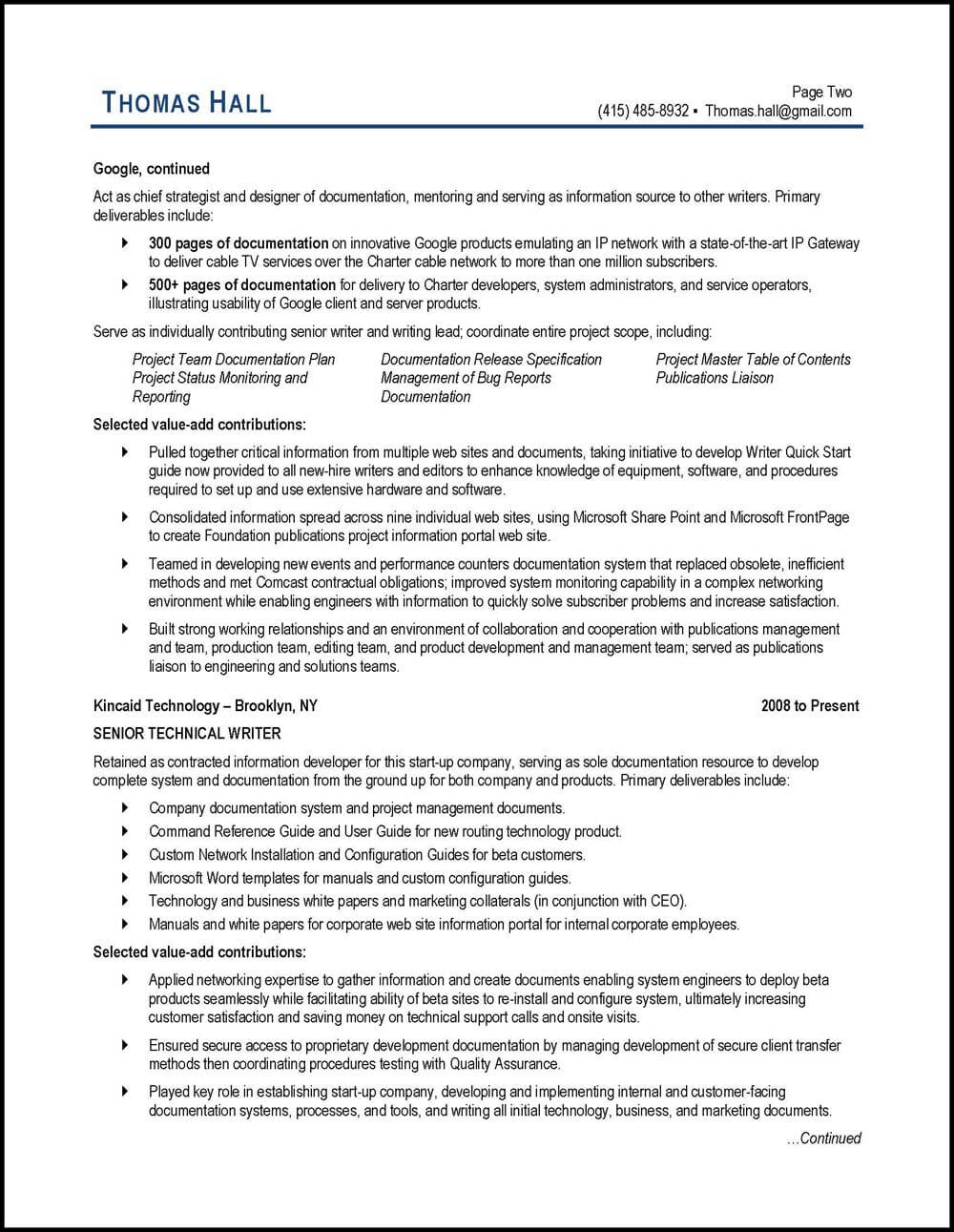
Every line says how the candidate can help. In addition, they don’t waste resume space by including an objective, a separate skills section, or any other information that isn’t relevant. The only thing I’d change here is to break the paragraphs into shorter bullet points.
They also put their skills, knowledge of software, and other relevant experience into their work job details. Kudos.
A tailored resume does not mean rewriting everything. It means adjusting what the reader sees first to match what they are hiring for.
I tailor three areas every time:
That’s the entire game. If the job posting repeats “error messages,” “onboarding guides,” and “usability testing,” your resume should include those terms, with supporting evidence.
I read the job description and highlight three categories.
Then I ask: which category does this company care about most? That tells me what to emphasize.
If you are applying to fintech, healthcare, or enterprise software, domain language matters. Industry-specific knowledge shows up in what you choose to include.
In fintech, clarity around money movement and error recovery matters. In healthcare, accessibility and risk language matter. In enterprise, information architecture and terminology consistency matter.
You do not need to pretend you are an expert. You just need to demonstrate that you can write for the domain and collaborate with subject matter experts.
Many UX writing roles mention collaboration platforms and writing tools. You should match the tool language when it is relevant.
If a job mentions Figma, it is not enough to list Figma. Show how you use it. “Wrote UI copy in components and partnered with designers in-file” is much stronger than Figma.
If a job mentions content management systems and you have worked with them, say so. It signals you can operate inside workflows, not just in a design file.
Most resume advice is generic. UX writers need a different lens, because their resume is judged as their writing.
Tip: Write Like a UX Writer, Not Like a Resume Bot
Resumes get weird because people think they need “resume voice.” That voice is stiff, vague, and jargon-heavy. Instead, write like you write product copy. Use clear verbs. Make one idea per line. Cut anything that sounds like filler.
Spelling errors and inconsistent capitalization look like product bugs. If you ship a typo in your resume, hiring managers assume you will ship typos in UI strings.
I do a three-pass proofread. First pass for content and logic. Second pass for grammar and typos. Third pass for formatting, spacing, and alignment.
If you can, have one other person review it. Fresh eyes catch what your brain auto-corrects.
If your bullets start with “Responsible for,” you are already losing. Everyone is responsible for something.
Replace “Responsible for writing microcopy” with “Wrote microcopy for onboarding and error recovery, improving clarity based on usability feedback.” Same truth, more signal.
Poor design on a resume is rarely “bad taste.” It’s usually a symptom of trying to compensate for weak content.
A UX writer resume should be simple. Clean typography, consistent spacing, and a structure that guides the reader through your proof.
AI-assisted content generation can help you draft, but it produces generic phrasing. Hiring managers recognize it.
If you use AI, you still need to make the language specific. Replace fluff with outcomes. Replace vague verbs with concrete actions.
Templates are useful as scaffolding, not as a shortcut. A resume template will not fix weak content.
A good UX writer resume template creates white space, clear hierarchy, and clean scanning. It doesn’t add decorative elements.
Resume builders are fine as long as they keep things clean. The risk is that they push you into standardized layouts that look like everyone else.
If you use a builder, focus on content quality. Your job is still to write achievement-focused bullets and a summary that says something.
I like a template that forces:
That’s enough. Anything beyond that is noise.
Finally, here are great examples of UX portfolios to check:
Your resume should match your portfolio narrative, not just your LinkedIn branding. If your portfolio says you specialize in onboarding and error recovery, your resume should reinforce that.
If you also submit a cover letter, keep the story consistent. Your resume is the “what,” your cover letter is the “why,” but they should point to the same strengths. If you need a cover letter framework that pairs well with an achievement-focused resume, this UX writer cover letter guide keeps things tight and proof-driven.
Here I answer the most frequently asked questions about UX writer resumes.
One page is ideal for most candidates. If you are very senior with deep experience, two pages can work, but only if every line earns its space.
Yes, and put it near the top. A UX writer resume without a portfolio link is like a product screen without a primary CTA.
Only include education and certifications that strengthen your story. If a program helped you produce portfolio samples, it is worth listing.
If it is just a badge with no proof to back it up, it rarely moves the needle.
Include tools that are relevant to the jobs you are applying for. Then, demonstrate tool use in your bullets by explaining how you collaborate with or ship work using those tools.
Describe observable outcomes. Mention fewer support questions, clearer usability test performance, reduced confusion in a flow, improved consistency after a content audit, or fewer copy revisions due to stronger systems.
They describe themselves rather than their outcomes. Hiring managers want to know what changed because you wrote the words.
Get the weekly newsletter keeping 23,000+ technical writers in the loop.
Learn UX writing and advance your career.
Please check your email for a confirmation message shortly.





















Get our #1 industry rated weekly technical writing reads newsletter.
Your syllabus has been sent to your email