
Our reviewers evaluate career opinion pieces independently. Learn how we stay transparent, our methodology, and tell us about anything we missed.

Our reviewers evaluate career opinion pieces independently. Learn how we stay transparent, our methodology, and tell us about anything we missed.
A few years ago, I got pulled into a product flow that had all the classic symptoms: users were dropping off, support tickets were piling up, and every team had a different opinion on what the UI text “should” say. I did what I thought a good writer does: I rewrote everything to be clearer. The copy was better, but the results didn’t move much.
What fixed it was the stuff nobody thinks of as “writing” at first: asking better questions in stakeholder meetings, aligning terminology across screens, using research notes to pick the right message at the right moment, and running a lightweight test before shipping. That project was my wake-up call. UX writing is a writing job, but the skills that make you valuable are bigger than writing.
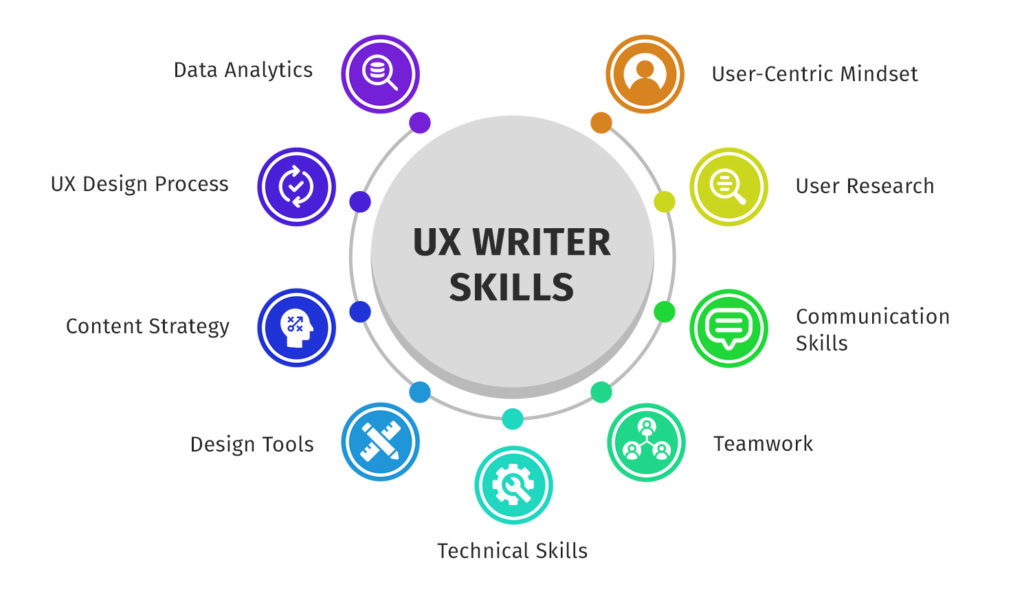
This is the obvious one, but most people misunderstand what “good UX writing” means.
Good microcopy is not clever. It’s effective. It helps users take the next step, recover from mistakes, and build confidence as they move through a product.
When I’m stuck between two “good” options, I’ll sanity-check against Google’s interface writing guidance in Material Design: Writing—it’s a fast reminder to stay clear, consistent, and user-first.
You’ll be judged on how you handle the high-impact UI surfaces:
Button labels should reflect the user’s intent, not the system’s internal language. Tooltips should reduce uncertainty, not add new concepts. Error messages should explain what happened and what to do next without blaming the user.
When I review portfolios (or coach someone on one), I look for screenshots and before-and-after examples because they show your thinking in context. In the middle of building your samples, referencing these UX writer portfolio examples helps you spot the difference between “nice writing” and “shippable UX writing.”
Write multiple options, then choose. That sounds basic, but it’s a serious skill.
Instead of “I picked the clearest,” you want to say: “I picked the one that reduces cognitive load at this step in the user journey.” That sentence alone signals maturity.
Consistency matters more than style. If you write “Sign in” in one place and “Log in” in another, you are creating friction.
Also, your writing needs to survive truncation, translation, and different screen sizes. That’s why short phrasing wins.
If you want to sound like a UX writer in interviews, talk about users like real people with emotions.
UX writing sits in moments where people are uncertain, rushed, or anxious. Your job is to reduce stress and make the next step obvious.
If you want a practical (non-fluffy) reference for writing that works for more people, W3C’s cognitive accessibility patterns—especially Use Clear Words—are a great checklist for high-stress UI moments.
User empathy is not “I care.” It’s “I can predict where confusion happens.”
That prediction comes from understanding user intentions, user needs, and the thought process behind a flow. It also comes from paying attention to product touchpoints where emotions spike: error states, payments, security prompts, account recovery, and anything involving personal data.
If you want to practice framing empathy as a professional skill, I like using UX writer interview questions as a drill and answering them using real examples from my own work.
You don’t need to quote behavioral economics to be effective. You just need to write about how people behave, not how the org chart thinks they behave.
For example, users skim. Users default to the primary button. Users panic when they see vague warnings. Your copy should reflect those realities.
Research is the fastest way to stop arguing about copy preferences.
When UX writers use research well, content decisions are based on evidence, not opinions.
You don’t need to be a researcher, but you do need research fluency.
That means you can use personas, run or support user interviews, read usability testing notes, and synthesize user feedback into content decisions. It also means you can ask scenario-based questions like: “What is the user trying to do at this moment, and what would stop them?”
A/B testing is great when you have it, but most teams don’t run experiments for every string.
Usability testing is more accessible. Even a small test helps you validate clarity. If you can pair that with analytics interpretation, you will stand out by connecting microcopy changes to user behavior.
When teams do have experimentation, you might hear tools like Optimizely mentioned, but the tool is never the point. The point is whether you can form a hypothesis, write variants, and interpret results like a product teammate.
Master the above skills to become an expert UX writer in our UX writing course.

This is the skill that separates “writer” from “content designer.”
When you can think about content structure, content flow, and information architecture, you stop being the person who fixes words and start being the person who fixes experiences.
Content audits are a big one. You scan a surface area and find inconsistent terminology, redundant instructions, mismatched voice, and missing states.
Content governance is another. If no one owns the standards, your product voice will drift. Even simple governance, like a naming convention doc and a lightweight review process, can prevent years of content entropy.
This is also where localization matters. Content that reads well in English can become confusing when translated. Writing with localization in mind is a real senior skill.
You don’t need to be an information architect, but you should understand how labels, menus, and navigation shape comprehension.
If your product has inconsistent screen titles or unclear taxonomy, even perfect microcopy won’t save the experience.
UX writing is less about writing and more about cross-functional collaboration.
A huge part of your value lies in your ability to work within teams without creating friction.
In most orgs, you will work with UI/UX designers, user experience designers, UX researchers, product managers, and developers.
In mature teams, you might also partner with content designers, content strategists, marketing teams, and accessibility specialists, depending on how the org is structured.
Active listening is underrated. So is asking good questions.
I like to summarize decisions in a brief recap after stakeholder meetings to prevent the same debate from recurring. Even a simple “here’s what we decided, here’s why, here’s what we need next” can save hours of churn.
Tools like Notion, Trello, or whatever your project management stack is don’t matter as much as visibility. Your goal is to keep work moving and keep decisions documented.
This is the skill that gets you influence, and influence changes your outcomes, your career progression, and often your compensation.
UX writers often need to advocate for clarity when stakeholders want cleverness, or advocate for user needs when business objectives are pushing in the other direction.
It’s not about “winning.” It’s about aligning expectations.
You clarify what success looks like, who the decision-maker is, and what constraints matter. That turns subjective debates into structured tradeoffs.
Relationship-building isn’t schmoozing. It’s building mutual respect.
I’ve seen “virtual coffee chats” sound corny, but they work when you use them to learn how other teams measure success. When you understand what a PM or developer is optimizing for, you can frame your UX writing decisions in language they care about.
That’s also how you build content allies. Once a few key people trust your judgment, your work ships faster.
UX writing changes because products change.
Adaptability is the ability to handle content-switching, shifting project requirements, and evolving business objectives without losing your mind.
Curiosity is what keeps you improving instead of repeating the same patterns forever.
Sometimes you’ll be deep in onboarding one day and rewriting error states the next. Sometimes the entire flow changes in a design review, and you have to adjust tone and structure.
You need boundaries to avoid burning out, but you also need flexibility to respond to product constraints.
Curiosity shows up as asking better questions, paying attention to industry trends, and learning from feedback.
It also shows up in performance reviews and self-reviews. The best writers I know can articulate what they learned, what they improved, and what they want to own next.
If you’re mapping curiosity to career growth, reading UX writer salary in the middle of planning your next skill push can help you connect “what I’m learning” to “what I can earn.”
You don’t need to be a designer or a developer, but you do need enough technical and design workflow fluency to collaborate.
Figma is the big one. You should be comfortable working in mockups, understanding components, and writing in context.
If you’ve touched other tools like Adobe XD or Sketch, that’s fine, but the real skill is understanding how UI prototyping and design thinking influence where copy belongs.
You don’t need to code, but understanding constraints matters.
Character limits, truncation, responsive layouts, and how strings are stored can all change meaning. Knowing how developers implement UI copy will make it easier to work with you and reduce rework.
Conversational design and chatbots are also becoming more common. If you can write for multi-turn interactions and maintain a consistent tone, that can be a differentiator.
Many people ask whether UX writing is closer to copywriting or to technical writing. The answer depends on the company.
If your work is in-product copy and microcopy, you’ll overlap more with copywriter skills. If your work includes help content, onboarding guides, and system documentation, you’ll overlap more with technical writers.
I like using UX writer vs technical writer in conversations with hiring managers because it helps clarify scope and expectations without sounding defensive.
If you want to grow fast in UX writing, build skills that make you valuable beyond the words.
Microcopy gets you in the door. Research fluency, content strategy thinking, collaboration, and advocacy are what make you senior.
If you’re early in your journey, the fastest path is still portfolio-first. While you’re building projects, use how to become a UX writer as a structure so your skills show up as proof, not claims.
Here I answer the most frequently asked questions about UX writer skills.
Writing clarity and microcopy fundamentals come first. Right behind that, you need collaboration habits and a basic understanding of user research so your decisions aren’t just opinion.
In most product teams, yes. You don’t need to be a UI/UX designer, but you should be comfortable writing in Figma files, working inside mockups, and collaborating on components.
No. Basic coding knowledge can help you understand constraints like character limits, truncation, and how strings are implemented, but it’s not a requirement for most roles. If you’re working with chatbots or conversational design, it helps to understand how flows are structured, even if you never write code.
I treat advocacy as expectation alignment. I use active listening in stakeholder meetings, clarify what success looks like, and propose options with tradeoffs. When you frame decisions around user outcomes, you build mutual respect instead of friction.
Start small and be consistent. Set up a couple of onboarding conversations or virtual coffee chats, ask each team how they measure success, and document what you learn. Over time, those personal connections create allies who support your work during reviews and performance cycles.
Get the weekly newsletter keeping 23,000+ technical writers in the loop.
Learn UX writing and advance your career.
Please check your email for a confirmation message shortly.





















Get our #1 industry rated weekly technical writing reads newsletter.
Your syllabus has been sent to your email