

I remember sitting in a review where a product manager asked for “some marketing spice” in an error message. The copywriter in the room did what copywriters do: they wrote something punchy. The UX designer did what designers do: they worried about confusion.
And I did what a UX writer does when they’re trying to keep the peace: I asked, “What do we want the user to do next?” That question changed the whole direction of the conversation. We didn’t need spice. We needed a clear recovery path.
UX writing is the words inside a digital product. Think navigation labels, onboarding steps, microcopy, tooltips, and the messages that appear when something goes wrong. The purpose is to support the user flow and reduce friction in the user interface (UI).
Copywriting is the words that convince someone to care, click, sign up, buy, or remember you. Think landing pages, marketing emails, social posts, ads, sales pages, and product positioning. The purpose is to move someone through the sales funnel and influence behavior using persuasion.
If you want a clean, mainstream definition of copywriting (without the “bro-marketing” vibe), Mailchimp’s explainer on what copywriting is nails the basics.
If you want a deeper baseline on what UX writing includes, I break it down in my guide to UX writing in a way that’s easier to map to real product work.
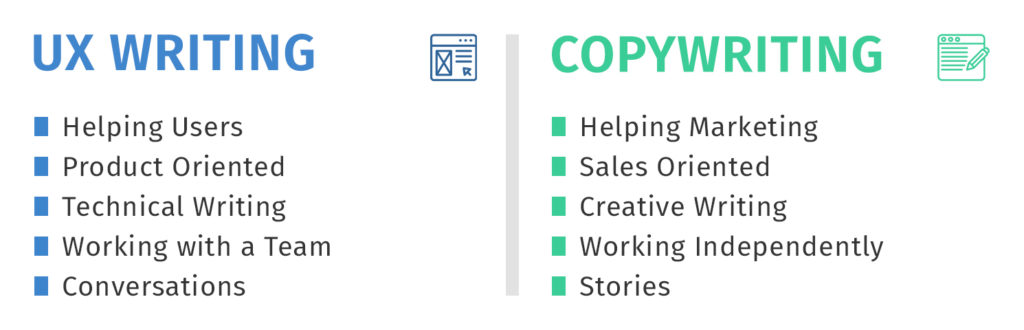
The simplest way I explain it is this:
UX writing optimizes for clarity and simplicity at the moment of use. Copywriting optimizes for attention and persuasion before and around use.
A UX writer is trying to reduce uncertainty and help users progress through a task. A copywriter aims to motivate action, shape brand perception, and generate demand.
UX writing leans neutral and supportive, especially in high-stress moments like payments, password resets, or error messages. Copywriting can be playful, bold, evocative, or hype-driven, depending on brand strategy.
UX writers write for users who are already inside the product and trying to do something. Copywriters write for potential customers, existing customers, or broad audiences across content channels.
UX writers write within constraints such as character limits, truncation, accessibility, localization, and component reuse. Copywriters have constraints too, but they’re more flexible.
When I need a quick “UI writing reality check,” I’ll pull up Google’s Material Design: Writing guidelines to keep labels and microcopy clean under real interface constraints.
Both roles require strong writing fundamentals, but the skill stacks diverge.
A UX writer needs microcopy craft, attention to detail, and a strong grasp of the design thinking process. They need comfort with qualitative and quantitative research, usability testing procedures, and working inside wireframing and prototyping tools.
If you want the full skill checklist, I keep it updated in UX writer skills, and it serves as a rubric for both hiring and self-assessment.
A copywriter needs storytelling, persuasion, and messaging instincts. They often need marketing methodology, search engine optimization, and the ability to write across different content formats.
They’re also closer to campaign strategy and brand positioning. That means the “best” copy isn’t always the clearest copy. It’s the copy that performs.
The overlap is in craft: clarity, rhythm, voice, and audience awareness.
The difference is what happens after the words ship.
UX writing = tasks done, confusion avoided; copywriting = clicks, leads, revenue.
Typical Tasks and Daily Responsibilities
This is where people get tripped up: both roles write “calls to action,” but the context and intent differ.
A UX writer might work on onboarding flows, error states, settings labels, confirmation dialogs, and content structure across a feature. They’ll collaborate inside the product design process, review microcopy in context, and align on terminology.
They also spend time on content audits, consistency checks, and refining how the product speaks across user journeys.
A copywriter might write landing pages, email campaigns, social media posts, brochures, scripts, and product marketing copy. They juggle multiple projects, move quickly, and iterate based on performance.
They may also work on campaign concepts, messaging frameworks, and creative briefs.
This is one of the biggest differences that people underestimate. UX writers live in product, copywriters live in marketing.
UX writers work with UX designers, user experience designers, product managers, UX researchers, developers, and sometimes localization and legal, depending on the product.
They operate in agile product development, including design sprints and rapid iteration cycles. They might also work with research operations if the org has a dedicated research pipeline.
The work environment tends to be “in the build.” You’re shaping content as the product evolves.
Copywriters work with the marketing team, email marketers, social media managers, creative directors, brand strategists, legal, and sometimes product marketing.
Their work environment is campaign-driven. You’re shaping content around launches, seasonal pushes, paid acquisition, and brand narratives.
The difference isn’t who works harder. It’s what system you’re optimizing for: product usability versus marketing performance.
You can learn all the technical details and skills required to become a UX writer with our UX writing course. To know more about the course learning outcomes, check out the course outline:

When you see examples side-by-side, the difference becomes obvious.
A UX writer might write:
For example, in a health app, UX writing might simplify symptom tracking flows so users feel confident entering data without anxiety. In the Airbnb app, UX writing might clarify booking steps and cancellation policies at the exact moment the user is deciding.
A copywriter might write:
The copy is broader and more emotional because it’s trying to create desire and urgency.
If you’re deciding what to hire, the most useful question is not “Do we need a UX writer or copywriter?”
It’s “Where is the problem happening?”
If the problem is in-product, like drop-off, confusion, broken flows, or unclear UI text, you need UX writing. If the problem is acquisition, positioning, conversion, or messaging across marketing channels, you need copywriting.
Here are the three most practical hiring signals I use:
Define team and success clearly. Mislabeling a UX writer wastes everyone’s time.
If you’re an individual choosing a path, here’s a helpful comparison: copywriting rewards creativity and performance outcomes, while UX writing rewards clarity, systems thinking, and research-informed decisions. If you want a bridge between product writing roles, UX writer vs technical writer can also help you understand how scope changes across writing disciplines.
UX writing and copywriting are both valuable, but they’re not interchangeable. When teams treat them as the same job, users feel it.
If you’re hiring, define the problem first. If you’re applying, position yourself based on the outcomes you drive.
Here, I answer the most frequently asked questions about a UX writer vs. a copywriter.
Yes, especially at smaller companies. The risk is that one person ends up context-switching, leading to a drop in quality. If you do both, I recommend being explicit about which work is in-product and which work is marketing, because they require different mindsets.
It depends on industry and scope. UX writing pay tends to track product org ladders, while copywriting pay can spike in performance marketing or senior brand roles. The bigger driver is scope, ownership, and how measurable the outcomes are.
Start by building product-focused samples, not marketing pieces. Study microcopy patterns, document your decisions, and create a small case study that shows how your writing improves a user flow.
If I’m a UX writer, should I learn copywriting?
It helps. Understanding persuasion and messaging can improve onboarding, upsell flows, and lifecycle moments. Just keep the UX writing priority intact: clarity first, then tone, then persuasion when it’s appropriate.
Get the weekly newsletter keeping 23,000+ technical writers in the loop.
Learn UX writing and advance your career.
Please check your email for a confirmation message shortly.





















Get our #1 industry rated weekly technical writing reads newsletter.
Your syllabus has been sent to your email