
UX Writer vs Copywriter: What’s the ACTUAL Difference?

By
Josh Fechter
Josh Fechter
I’m the founder of Technical Writer HQ and Squibler, an AI writing platform. I began my technical writing career in 2014 at…
More About Josh →

People often confuse a UX writer with a copywriter. These two are two different writing categories.

Amazon, Google, Microsoft, and major tech companies have defined separate departments for UX writers and separate departments for copywriters. But what are these writers doing? How are they different from each other? Is UX writing a skill worth learning and enough to carry as a full-time career?

UX is an advanced form of technical writing that involves writing website content aligned with the UX design. UX writers collaborate with graphics and UX/UI designers using tools like Figma and Adobe XD.

If you want to learn more via video, then watch below. Otherwise, skip ahead.

What is the Difference Between a UX Writer and a Copywriter?

UX stands for User Experience. As UX design enhances the user experience, so does the UX writing.

UX writing is writing user interface microcopy for a product that provides a guide to using it. Users often encounter this copy while using a product.

On the other hand, copywriters write content to market a business’s services or products. This writing focuses on increasing product sales, while UX writing primarily focuses on the design and efficient use of a particular product. Copywriters rely on market research data and formulas to write creatively and improve sales.

UX writers are sometimes also called content strategists or content designers. The content designer is an outdated term that content strategist now replaces, but it is still not a proper term for defining a UX writer’s job description.

UX writers also help write content strategy alongside the product manager. They mainly rely on Figma and other collaborative design tools, such as Adobe XD, for communication. A good user experience highlights UX writing.

Consider this real-life scenario to understand the difference between UX writing and copywriting. According to a study of a Google search on hotel rooms, it was found that people felt a sensation of commitment with a copy that says “Book a Room” while it was just to check the availability of space. A considerable difference was spotted when the copy was replaced with “Check Availability” instead of “Book a Room”.

This practice is the power of good UX writing in comparison to simple copywriting. This minor change increased traffic and engagement by 17%.

UX writing vs copywriting

As these terms are different, but not all the differences are black and white, let’s have a look at these points to understand the significant differences:

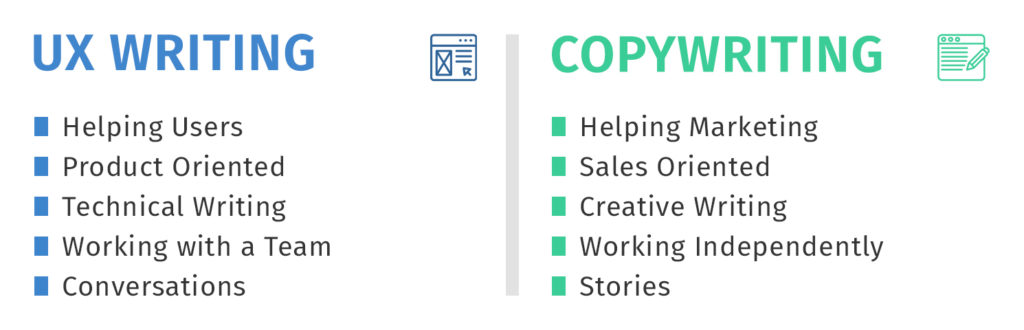
1. Helping Marketing a Business vs. Helping the Customers

Although both UX writers and copywriters help businesses and customers, UX writing primarily focuses on assisting customers complete a task. The job is to simplify the use of a product, which increases customer satisfaction and builds greater trust in the business.

No doubt, good copywriting skills help customers as well, but the goals are primarily profit-oriented. In copywriting, the text is tempting and appealing to users, which intimidates them and leads them to take action in support of business marketing.

In short, UX writing helps customers, while copywriting helps grow sales.

2. Sales-Oriented vs. Product-Oriented

Copywriting is sales-oriented, while UX writing is product-oriented. Copywriting increases sales, while UX writing simplifies the way a product is used with simpler words.

UX writers do not tend to write copy that attracts potential buyers or customers; instead, they use simpler language to explain processes and features to users.

A copywriter writes with a focus on impressing the reader and intimidating them into taking action. The words are compelling and engaging so that the reader either sticks with the text or takes an action in support of the business that leads to more sales and profit.

3. Design Tools vs. Quantitative Research

Figma and Adobe XD are two collaborative design tools. UX writers primarily use these tools for communication with designers.

Figma is a collaborative tool used to create interface designs for web and apps. It is a collaborative tool that multiple teams can use in real-time. The tool’s collaborative feature assists with UX writing. Similarly, UX writers use Adobe XD for real-time collaboration with various teams. It is a UX/UI design tool with the same live collaboration feature.

On the other hand, copywriters are sole workers. They rarely require collaborative design tools. Instead, their work relies entirely on formulas and numbers derived from quantitative research. They write with their creative minds to market digital products.

4. Technical vs. Creative Writing

UX writing falls under the technical writing niche, while copywriting falls under the creative writing niche.

A UX writer should be familiar with backend technicalities so they can translate complex information into simpler terms. This helps users and improves comprehension and readability.

At the same time, a UX writer should have insightful, dynamic thinking to help the customer by providing clear insights into the main issue.

On the other hand, copywriters often use creative writing skills to engage readers. They are not aware of the technical terms or backend processes. But they must be able to trade on users’ trust and compel them to purchase the business’s support.

5. Marketing vs. User Experience

UX writing focuses on User Experience, while copywriting focuses on marketing. User experience and marketing are two distinct terms that shouldn’t be conflated.

Marketing is the act of promoting and selling your business’s products or services. Some marketing methods include selling, advertising, and delivering products to customers.

User experience is the experience of a person while using a product or benefiting from services. User experience is the level of client satisfaction with a product.

Hence, UX copywriting should be done with a focus on client satisfaction, and the user experience reflects how easy it is to use a product.

Good copywriting focuses on promoting and marketing a business’s services and increasing sales.

6. Comparing Salaries

Glassdoor lists the median annual salary for UX writers at $85k, and for copywriters at $85k.  Find a more detailed overview of a UX writer’s salary here.

7. Working Alone vs. Working with Team

A major difference between UX writers and copywriters is that UX writers always work alongside the UX design team, while copywriters work alone. Copywriters don’t need the assistance of any other department’s team and are independent to write compelling business copy.

UX writers often engage with the UX design team. This way, UX writers have a greater focus on the product strategy and goals, depending on the product design. The greater the interaction with teams, the better the output will become. The UX designer also works by keeping the UX writers’ work in view.

Meanwhile, copywriters can work with any team. They work alone without considering the product design; they are just meant to sell it more. Sometimes, a copywriter can also work with marketing departments or content writing teams to share new ideas.

8. Stories vs. Conversations

Copywriters tell stories, while UX writers share conversations.

A UX writer’s focus is on providing a solution to a problem, and not telling stories. The moment a UX writer starts writing novels in the copy rather than solving a customer’s problem, it erodes the user’s trust in the brand.

Storytelling is mainly a copywriter’s skill, who tries to impress readers with the stories they tell.

There’s no hard-and-fast rule about telling stories in copy, but if you are talented enough to embed stories that provide a solution to the problem, it is no less than a blessing. And in such cases, it is not prohibited either.

A UX writer can share conversations to help the reader in all possible ways. Many copywriters take advantage of stories to impress the reader.

Copywriter vs. UX Writer: Primary Difference

Many UX writers are ex-copywriters. They also write copy, but with completely different writing goals.

One of the most visible differences between these two is that UX writers are not in any way linked with the marketing team. But in fact, UX writers are a part of the UX designers’ or product designers’ teams. The copy a UX writer writes does not increase sales, enhance brand voice, or market the product. Instead, their main writing goal is to enhance the experience of users and not to sell a product.

While copywriters always work with the marketing team, they focus more on promotional materials and selling the products and not on the user experience.

A UX writer writes error messages, instructions, mobile apps notifications, chatbots, screen messages, form fields, and control button copy.

Copywriters write copy for landing pages, product descriptions, white papers, print ads, newsletters, social media posts, and slogans.

What is a UX Writer?

A UX writer is a product-focused content specialist who writes text that appears directly within user interfaces, such as microcopy. This includes button labels, onboarding instructions, tooltips, empty state messages, form field placeholders, and error messages. Their primary responsibility is to create clear, concise, and helpful copy that supports user experience (UX) and helps people navigate a product easily.

UX writers work closely with design teams, product managers, researchers, and engineers. Their copy is often integrated into UI elements and tested for effectiveness through UX research and usability testing. Their work isn’t just about words, it’s about understanding the product vision, applying UX design principles, and making sure every interaction feels smooth, intuitive, and on-brand.

While their writing may appear short, it serves a functional purpose: removing friction from the user journey. For example, instead of just labeling a button “Submit,” a UX writer might use “Send Feedback” to better reflect the action and reduce confusion. This clarity helps users feel more confident and improves a product’s overall usability.

What is a Copywriter?

A copywriter is a content creator focused on marketing and persuasion. They write content that grabs attention, communicates value, and encourages users to take action. This includes landing pages, marketing emails, ad campaigns, product descriptions, and other forms of promotional content.

The core responsibility of a copywriter is to convert interest into engagement, measured by actions such as sign-ups, downloads, purchases, or click-throughs. Their writing must align with brand strategy and often involves applying storytelling techniques, emotion-driven messaging, and search engine optimization (SEO).

Unlike UX writers, copywriters work more frequently with marketing teams than product teams. Their work appears outside of the product itself, on websites, emails, social channels, and other customer-facing touchpoints. They’re often measured on campaign performance and may be responsible for crafting the brand voice across multiple platforms.

Can a Copywriter Become a UX Writer?

Absolutely. Many UX writers started their careers as copywriters and successfully transitioned by shifting their focus from selling products to solving user problems.

To move into UX writing, a copywriter must learn how to write for digital products instead of campaigns. This includes understanding functional UX copy, writing for user interfaces, and applying the principles of content design. UX writers base their work on user needs, informed by UX research and usability testing, rather than marketing goals.

Transition steps may include:

  • Studying UX writing and design thinking principles
  • Learning how to collaborate with design teams and product managers
  • Practicing writing UI-focused content like buttons, modals, and microcopy
  • Gaining familiarity with tools like Figma, Notion, or content management systems (CMS)
  • Creating case studies or mock projects to build a UX portfolio

Where copywriting prompts action, UX writing guides action. Both are valuable, but they serve different purposes and require different mindsets.

You can learn all technical details and skills required to become a UX writer with our UX writing course. To know more about the course learning outcomes, check out the course outline:

By learning the fundamentals of user design, a copywriter can write a UX copy depending on the UX design and log user data into the writing.

As soon as any writer jumps into the user experience and user testing, they start developing a UX writer’s mindset to increase user empathy. So, this is the first method to train a copywriter to become a UX writer. This makes UX writing user-centered writing.

Another way is to pair copywriters with UX designers and limit the designers to a single UI task. This way, the copywriter can learn to write from the user’s perspective.  This practice works well when a copywriter switches between a marketer/advertiser’s role and a UX writer’s role to enhance the brand voice and the customer’s experience. This way, they can design a copy well-suited for both users and marketers.

Although the writing goals of the two writers differ, both can switch jobs by learning and adding specific skills to their job duties.

To become a UX writer, it is necessary to know about the design and technical features of the digital products you’re writing for.

Conclusion

As soon a copywriter’s and UX writer’s mindset matches, and they start working along with each other, that’s when you balance the needs for users and businesses at the same time with a successful outcome from both ends.

UX writers and copywriters are two different roles with unique skills and strengths, but these roles are often intermixed up with each other.

A UX writer writes with a focus on UX design to enhance user experience, while a copywriter writes to market and promote business sales.

A copywriter can become a UX writer, and similarly, a UX writer can become a copywriter while this transition is easier in comparison to the former.

Both these writers have a unique writing skill set, and they work accordingly to achieve business goals.

FAQs

These questions address the core differences between UX writers and copywriters, including their skills, responsibilities, and deliverables.

1. What is the difference between a UX writer and a copywriter?

A UX writer focuses on writing microcopy that helps users navigate a product, such as button labels, error messages, and onboarding instructions. A copywriter, on the other hand, writes persuasive content like ads, landing pages, and product descriptions designed to attract and convert users. UX writing supports the user interface, while copywriting supports marketing goals.

2. What skills are essential for UX writers compared to copywriters?

UX writers need to understand UX design principles, user research, collaboration with design teams, and tools like wireframing platforms or CMS systems. Copywriters focus more on storytelling, SEO, brand voice, and crafting compelling content across various channels. Both roles benefit from strong writing, creativity, and audience awareness.

3. How do the goals of UX writing and copywriting differ?

The goal of UX writing is to enhance the user experience by guiding users through a product clearly and efficiently. It prioritizes usability, clarity, and minimal friction. Copywriting, however, aims to drive action, such as signups or purchases, by creating engaging and persuasive messages aligned with a brand’s tone and strategy.

4. What are some best practices for UX writing vs. copywriting?

UX writing best practices include using inclusive language, following content style guides, conducting usability tests, and iterating based on user feedback. For copywriting, best practices involve audience research, testing messages with A/B tools, optimizing for search engines, and maintaining a consistent voice across campaigns.

5. Can you give examples of work done by UX writers and copywriters?

UX writers create microcopy for onboarding flows, navigation labels, error messages, chatbots, and confirmation modals. Copywriters produce landing pages, sales emails, product descriptions, ads, and brochures. Their outputs serve different touchpoints in the user journey.

6. Do these roles ever overlap?

Yes, especially in smaller teams or startups. A writer might handle both UX microcopy and marketing content. However, in more mature organizations, the roles are often split because each requires different goals, tools, and collaboration styles.


If you are new to UX writing and are looking to break in, we recommend taking our UX Writing Certification Course, where you will learn the fundamentals of being a UX writer, how to dominate UX writer interviews, and how to stand out as a UX writing candidate.

Stay up to date with the latest technical writing trends.

Get the weekly newsletter keeping 23,000+ technical writers in the loop.