
Our reviewers evaluate salary independently. Learn how we stay transparent, our salary methodology, and tell us about anything we missed.

Our reviewers evaluate salary independently. Learn how we stay transparent, our salary methodology, and tell us about anything we missed.
Document Control Manager pay lands in the high $80Ks to high $90Ks nationally, but it swings hard by location and industry. Below, I’ll break down pay ranges, top-paying cities, benefits, and the fastest ways I’ve seen people grow their income.
Alright, let’s talk money.
When I sanity-check salary data, I like to look at two different “types” of sources:
On the self-reported side, PayScale shows an average base salary of around $87,345, with a typical base range of $56K to $120K, plus bonuses and profit sharing that can push total compensation higher.
On the job-market side, ZipRecruiter pegs the national average around $98,940, with the 25th percentile around $74K and the 75th percentile around $118K (and top earners reported around the low $140Ks).
So why the gap? Because “Document Control Manager” is a title that gets used for a few different realities:
If you’re interviewing, the salary range you should anchor on depends on which version of the role you’re stepping into.
Most people fixate on base salary (fair), but document control manager compensation often has a couple extra layers that matter:
This is your steady paycheck. PayScale’s base range is $56K to $120K, with an average base around $87K.
PayScale reports bonuses roughly $1K to $11K, and profit sharing up to about $9K for this role. Not everyone gets this, but it’s common enough that I ask about it directly.
Some salary models call anything beyond base “additional pay.” That can include performance bonus, cash bonus, stock (less common here), and sometimes project-based incentives. PayScale’s total pay range lands around $56K to $126K.
A small but practical negotiation tip: If the base is tight, ask whether they can move one of the “other levers,” like a sign-on bonus, quarterly bonus eligibility, or a professional development budget (EDMS training, ISO lead auditor prep, project management courses, etc.).
Even a modest training budget can pay for itself fast if it helps you become the person who solves the ugly document control issues nobody else wants.
Location still matters, even in a world where a lot of document control happens in digital platforms.
ZipRecruiter’s “top 10 highest paying cities” list is a good snapshot of where pay tends to spike. What jumped out to me is how often California shows up, plus a couple of smaller markets where demand outstrips supply.
Here are a few from that list:
Two quick observations (the kind I wish someone told me earlier in my career):
If you want more context on how these workflows run, I’d read my breakdown of the document control process and the broader document control overview. Those two pages will make job descriptions feel a lot less vague.
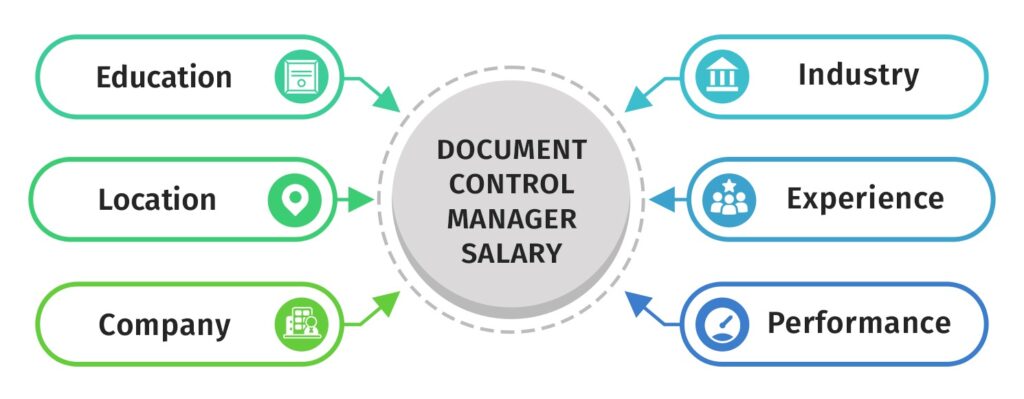
If you’re trying to predict where you’ll land in the range, here are the biggest levers I see (and what I’d optimize for).
PayScale lists an entry-level (under 1 year) total compensation around $55,146, and an early career (1 to 4 years) total compensation around $73,411.
But the more important predictor than “years” is scope:
If the answer is “yes” to most of those, you’re not just a coordinator with a fancy title. You’re operating like a manager, and you should price yourself that way.
Highly regulated environments often pay more because the consequences of mistakes are higher. If you’re living inside a quality management system, preparing for audits and inspections, or enforcing ISO standards and version control discipline, you’re providing business safety, not “admin support.”
That’s also why experience in construction, pharma, healthcare, energy, and manufacturing can punch above its weight in salary negotiations.
This is the part that’s often undervalued until it becomes the central focus of the role. If you can walk into a new organization and effectively manage business systems, you’ll immediately stand out as a faster, safer hire.
These systems include:
Understanding and mastering these tools not only helps you manage workflows efficiently but also positions you as someone who can mitigate risks and enhance overall operational reliability.
And if you want a shortcut to understanding what employers expect from the “manager” tier, start with what a document control coordinator actually does day-to-day and then compare that scope to the manager job descriptions you’re seeing.
Compensation isn’t just salary, especially in roles that sit close to compliance, quality, and project delivery. Benefits can make a “meh” offer feel solid, or make a “great” base salary feel like a trap.
From PayScale’s survey data for this role, common health benefits look like:
Beyond health coverage, the perks I most commonly see Document Control Managers negotiating (or regretting not negotiating) are:
If you’re comparing offers, I’d rather you ask “what’s the total package?” than get hypnotized by a base salary number.
“Top paying companies” is a slippery phrase, because salary pages often rely on small sample sizes. But it’s still useful to look at real employer ranges to understand what’s possible, especially if you’re targeting EPC, energy, or infrastructure-heavy organizations.
Here are a few examples that show up in Glassdoor ranges for Document Control Manager pay:
Notice what these employers tend to have in common: complex operations, heavy project load, and real consequences for document control issues.
If you want to increase your odds of landing in those higher bands, don’t just market yourself as “organized.” Market yourself as the person who can build scalable document control processes across cross-functional teams, clean up documentation workflows, and create reporting that upper management can actually use.
The fastest career growth I see in document control usually follows one of these paths:
If you love deadlines, coordination, and cross-team execution, document control can be a strong stepping stone toward project controls or project management. You already live in change workflow, approval cycles, and the messy reality of getting people to follow document control procedures.
A lot of hiring managers value this because it’s rare to find someone who’s both process-minded and good with stakeholders.
If you like standards, audits, and doing things “the right way,” the next step can look like quality documentation leadership inside a QMS. This is where knowledge of ISO standards, SOP design, version control governance, and regulatory requirements becomes career-defining.
Some Document Control Managers grow into broader documentation manager roles, owning not just control, but also documentation strategy, templates, and governance across the org. If that’s interesting, you can compare the scope in my guides on what a document manager does and what a documentation manager does.
To be clear, you don’t need an advanced degree to advance, but you do need a track record of owning outcomes: cleaner audits, fewer document change errors, faster retrieval, tighter security, smoother handoffs, better reporting.
PayScale reports a job satisfaction rating of 3.5 out of 5 for Document Control Managers (based on a small number of responses), which lands in the “highly satisfied” bucket.
On the demographic side, the role appears to skew female in multiple datasets:
I’d treat all of these as directional, not absolute. But if you’re researching the field, it’s useful context.
My bigger takeaway is this: Satisfaction tends to be higher when the role is empowered. If you’re positioned as a real owner of document governance (not just the person chasing signatures), the work feels more strategic, and the compensation usually follows.
If you’re trying to level up your earning power, skill-stacking works. A Document Control Manager who can lead people, run audits, manage systems, and partner with project management tends to move up faster than someone who’s “just” great at filing.
Here are the most frequently asked questions about Document Control Manager salaries.
Some datasets put the upper end of the base salary range around $120K, with total compensation sometimes higher depending on bonus and profit sharing.
Entry-level or smaller-scope roles can land in the mid-$50Ks range, especially if the title “manager” is being used loosely.
The most reliable levers are (1) switching to an employer or industry that pays more, (2) expanding your scope into people management and governance, and (3) building deeper expertise in compliance, audits, and document management systems.
Yes. Location premiums can be significant, especially in high-cost markets or project-heavy regions where demand is high.
People management, project coordination, EDMS/DMS ownership, audit readiness, SOP design, version control governance, and strong reporting (document control metrics) tend to be the biggest differentiators.
It depends on the company. In some orgs it’s administrative coordination, and in others it’s full ownership of document governance, systems, compliance, and cross-functional workflows. The pay usually reflects which version you’re getting.
Get the weekly newsletter keeping 23,000+ technical writers in the loop.
Learn documentation engineering and advance your career.
Please check your email for a confirmation message shortly.





















Get our #1 industry rated weekly technical writing reads newsletter.
Your syllabus has been sent to your email