
Our reviewers evaluate salary independently. Learn how we stay transparent, our salary methodology, and tell us about anything we missed.

Our reviewers evaluate salary independently. Learn how we stay transparent, our salary methodology, and tell us about anything we missed.
I’ve learned that “grant writer salary” is a tricky question, because two people with the same title can be doing completely different jobs.
One grant writer might be writing two foundation proposals a month with a light budget narrative. Another might be coordinating federal submissions, wrangling attachments, tracking compliance, and supporting post-award reporting. Those are not the same role, and the compensation usually reflects that.
If you want a refresher on what the job includes (and why it impacts pay), start with my overview of what a grant writer does.
When you look up the “average grant writer salary,” you’ll see different numbers depending on the data source. That’s normal. Each site uses different inputs, like self-reported salaries, job postings, or employer estimates.
Here are a few widely referenced snapshots in late 2025 through January 2026:
So if you’re trying to ground your expectations, I usually treat it like this: the mid-range for many general grant writer roles often lands somewhere in the high-$50k to mid-$60k area, then shifts up as complexity and ownership increase across budgets, compliance, and post-award work.
If you’re seeing much higher averages on certain salary sites, it’s often because they’re blending “grant writer” with roles that look more like grants manager, development manager, or senior proposal lead. Salary.com, for example, lists a much higher benchmark than the sources above.
This is the part most salary roundups skip. Pay usually tracks responsibility, not just writing quality.
If your role is mostly narrative writing and basic submissions, you’ll often land in the lower-to-mid range. If your role includes budgeting, compliance, and cross-team coordination, you usually move up.
Here’s the cleanest way I think about it:
You can see this when you compare a “proposal-only” workflow to a full lifecycle workflow that includes grant reporting, renewals, and strategic funding plans.
If you’re actively job hunting right now, it helps to align your resume to the responsibility level you want, not just the title. My guide on grant writer resumes walks through how to signal that scope without sounding inflated.
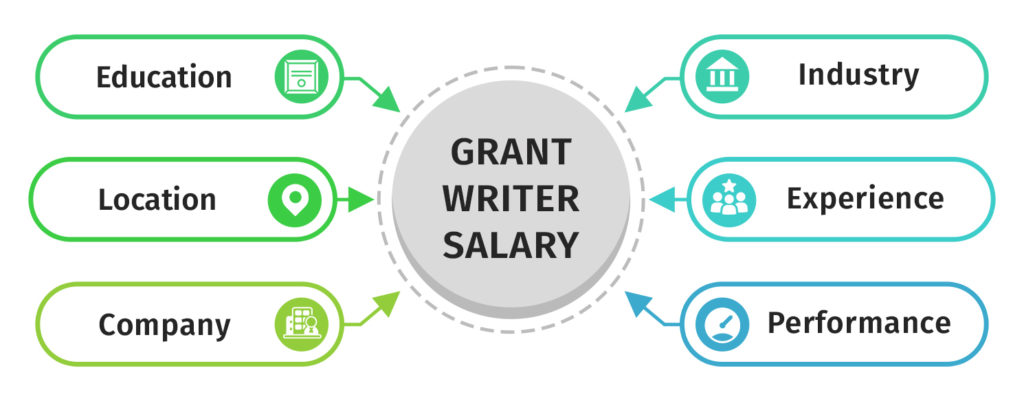
Most grant writer compensation comes down to a handful of drivers. I’ll keep this simple and practical, because you’ll feel these in job postings immediately.
Location and cost of living still matter too, especially in large metro areas, but responsibility tends to be the lever you control most.
Freelance grant writing is where people get confused fast, because hourly rates and project-based rates can look wildly different on paper.
Hourly rates are common when the scope is unclear, the organization is still gathering inputs, or the grant is a moving target. Project-based rates tend to show up when the deliverables are predictable, like one narrative, one budget narrative, and a defined list of attachments.
If you’re budgeting grant writing costs as a nonprofit, the safest approach is to define the scope first (number of pages, budget complexity, number of partners, number of attachments, and whether reporting support is included). “Write a proposal” is not a scope. It’s a wish.
If you’re a freelancer trying to price confidently, I recommend building your pricing around the real work: discovery, outlining, narrative drafting, revision cycles, compliance checks, and submission management. The writing is only one part.
This is one of the most common compensation questions, and the answer is: sometimes, but it depends on the funder rules and how the role is scoped.
For U.S. federal awards, compensation for employees working on a federal award can be allowable when it’s tied to the period of performance and properly documented. The federal Uniform Guidance includes specific rules on compensation and how costs are charged.
Here’s the nuance that matters in real life:
If the grant writer is doing work to carry out the funded project during the award period (for example, grant reporting, documentation, coordination, or program-related communications that are part of the project), that compensation may be allowable if it meets the funder’s requirements and the organization’s cost policies.
If the grant writer is doing proposal preparation for future funding opportunities, federal guidance typically treats proposal costs as indirect costs that are allocated across organizational activities, rather than a direct charge to a single award.
In plain terms: paying someone to execute and report on the funded work is often easier to justify than paying someone to write future applications using current award funds.
You should still review the specific grant terms, because agencies and foundations can add restrictions beyond the general federal cost principles. If you want a practical way to stay compliant, build a habit of mapping every budget line item to an activity and deliverable.
The fastest salary growth for grant writers usually comes from expanding scope, not just getting “better at writing.”
When you can take ownership of the full proposal lifecycle, you move into roles like senior grant writer, grants manager, grant writing manager, or development operations lead, depending on the organization.
The skills that tend to unlock higher compensation are:
If you want a straightforward roadmap for developing those skills, I usually point people to structured training plus real artifacts. A good starting point is building a portfolio of samples and then tightening how you present them in interviews, using grant writer interview questions as your practice framework.

Here are the most frequently asked questions about the average grant writer salary.
Most major salary sources place the U.S. average somewhere in the upper-$50k to mid-$60k range, but the exact number depends on the dataset and how the role is defined. If the position includes budgeting, compliance, and post-award responsibilities, compensation often trends higher than writing-only roles.
It depends on the scope and the funding complexity. Roles tied to government agencies or federal grants often pay more when they include compliance, documentation, and reporting expectations, but some nonprofits also pay well for senior talent who can consistently secure large awards and manage renewals.
Both. Hourly is common when scope is uncertain or inputs are incomplete, while project-based rates work best when deliverables are clear and repeatable. The real driver is how defined the scope is, not which pricing model is “better.”
Sometimes. Compensation tied to performing work during the award period can be allowable if it’s properly documented and permitted by the funder’s rules. Proposal preparation costs for future awards are often treated differently under federal guidance, so it’s important to separate “delivery and reporting work” from “writing new applications.”
Budgeting and budget narratives, compliance and reporting experience, federal grant familiarity, strong stakeholder management, and project management. In my experience, the more you can own the lifecycle and reduce risk, the more leverage you have in compensation conversations.
It can be, mostly because deadlines, funding pressure, and stakeholder coordination are built into the work. The stress level usually drops when you have a repeatable process, clear internal deadlines, and leadership that treats grants like a system instead of a last-minute emergency.
If you are new to grant writing and are looking to break-in, we recommend taking our Grant Writing Certification Course, where you will learn the fundamentals of being a grant writer, how to write proposals that win grants, and how to stand out as a grant writing candidate.
Get the weekly newsletter keeping 23,000+ technical writers in the loop.
Learn grant writing and advance your career.
Please check your email for a confirmation message shortly.





















Get our #1 industry rated weekly technical writing reads newsletter.
Your syllabus has been sent to your email