Our reviewers evaluate career opinion pieces independently. Learn how we stay transparent, our methodology, and tell us about anything we missed.

Our reviewers evaluate career opinion pieces independently. Learn how we stay transparent, our methodology, and tell us about anything we missed.
If you’ve ever opened a help doc, tried to follow it, and still ended up thinking “okay… but what do I do?”, that’s the gap technical writing is supposed to close. And the frustrating part is that closing it has very little to do with sounding smart (or “writing well” in the academic sense).
In this guide, I’m breaking down the technical writing skills that actually make documentation useful in the real world.
If there’s one skill that separates “a person who can write” from “a technical writer,” it’s audience awareness.
Most documentation fails for one simple reason: it’s written for the writer’s brain, not the user’s brain. The best technical writers obsess over what the reader is trying to do, what they already know, and what they’re likely to misunderstand.
When I’m writing, I’m quietly doing audience analysis, even if nobody calls it that. I’m asking: what’s the user base here? Are these beginners, power users, admins, developers, clinicians, customers on a deadline? What’s their level of technical knowledge? What’s their motivation? Are they curious, frustrated, stuck, or just trying to finish a task fast?
This is where demographics and context matter, but not in a marketing way. It matters because it changes how you explain things. A developer integrating an API wants precision and examples. A non-technical user wants a straight path and fewer new terms. Someone reading in a crisis wants calm, direct, predictable steps.
Empathy in technical writing is basically: “I can picture the reader’s level of understanding and adjust my writing style accordingly.”
That might mean writing in an active voice, using simpler sentence structure, defining terms before you use them, or cutting “nice-to-know” content that slows them down.
If you want to see how interviewers probe for this skill, skim technical writer interview questions and pay attention to the audience and clarity section.
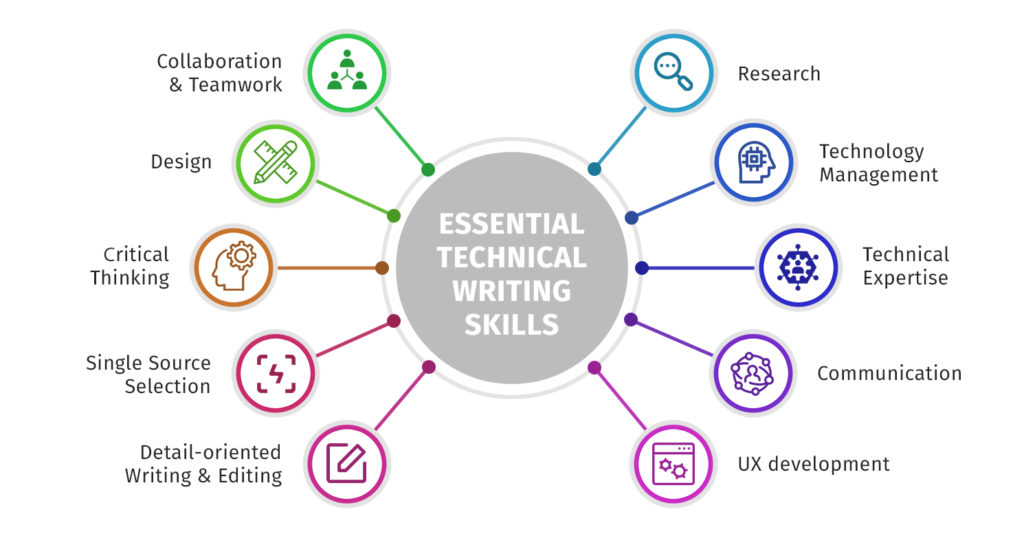
A technical writer who can’t collaborate will struggle, even if they’re an amazing writer.
This job is constant communication: with subject matter experts, project managers, content editors, website designers, product managers, developers, and sometimes clients. Your ability to gather accurate information and manage feedback often matters more than your ability to craft the perfect sentence.
A lot of technical writing is asking good questions. Not “Can you explain this?” but “What does the user need to do first?” “What are the failure modes?” “Is this behavior consistent across environments?” “What changed in this release?”
And the skill isn’t just asking. It’s keeping the conversation efficient. SMEs don’t want a writer who requires 12 meetings to get one answer. They want someone who shows up with context, makes judgment calls when appropriate, and confirms decisions clearly.
There’s a subtle persuasion skill in technical writing.
Sometimes you’re persuading an engineer to give you five minutes of time. Sometimes you’re persuading a team to adopt consistent terminology. Sometimes you’re persuading stakeholders that documentation isn’t a last-minute task you can squeeze in on launch day.
The writers who grow fastest are the ones who can advocate for quality without being “the documentation police.”
Technical writers make judgment calls constantly, even when nobody acknowledges it. You’re deciding what to include, what to cut, what order to present steps in, what to define, what to assume, and what to flag as unclear. You’re also deciding what the source of truth is when different people disagree.
Good documentation has a logic to it. It’s not just grammatically correct, it’s organized in a way that matches how users think.
That’s why critical thinking shows up as information processing: you take messy input from multiple sources, resolve conflicts, and build a clear path. You’re doing problem solving skills work, not just writing.
Sometimes the “problem” isn’t technical. It’s people. Two stakeholders disagree. A feature is changing while you’re documenting it. A doc review stalls. A team wants you to publish something you don’t think is accurate.
This is where calm conflict resolution skills and decision-making skills matter. You don’t need to be dramatic. You just need a clean approach: clarify the audience goal, identify the conflict, propose options, and get the right person to decide.
You don’t have to be a designer to be a strong technical writer, but you do need basic information design instincts. If the doc is visually exhausting, people won’t read it, even if the writing is great.
I’m always thinking about subheading distribution, spacing, and whether the page “breathes.” I want a reader to be able to land on a doc and quickly find the relevant section.
That often means using headings intentionally, breaking up dense paragraphs, and using tables only when they genuinely help. It also means using visual aids like screenshots, diagrams, illustrations, and occasionally graphs or figures when the concept is easier to understand visually than verbally.
Depending on the org, design work might be lightweight or heavy. You might touch tools like Adobe Illustrator or Adobe Photoshop for simple image cleanup, or you might just be creating clean tables and screenshots in a help center.
For web-based docs, it helps to have a basic understanding of HTML and CSS, even if you’re not writing front-end code daily. It makes you better at troubleshooting formatting issues and collaborating with website designers.
Tool proficiency is one of the fastest ways to become “easy to hire.” Most teams don’t expect you to know every tool, but they do expect you to learn quickly and not fight the workflow.
In the wild, you’ll see a mix of:
The important part is that you understand document management and how content moves through a documentation authoring workflow: drafting, review, approval, publishing, and maintenance.
At some point, you’ll run into “single sourcing” (or single-sourcing) and content reuse systems. Even if you don’t become a structured authoring expert, it’s worth understanding the concept: write once, reuse many times, and keep updates centralized.
That’s the difference between a doc set that scales and a doc set that rots.
Technical writing is research-heavy, even when the job title doesn’t say it. You’re constantly collecting background information, verifying claims, and synthesizing sources into something usable.
In practice, research looks like a mix of:
When you’re writing for regulated or high-stakes environments, research and fact-checking become part of your credibility. It’s not optional.
If you’re documenting user experience problems, case studies can be powerful. Especially when you tie doc changes to outcomes like fewer repeat questions or fewer escalations.
Even lightweight metrics help. You don’t need perfect numbers. You need evidence that you’re paying attention to what users struggle with.
A lot of technical writing success comes down to organization and planning. The best writers don’t just write. They run a process.
Before I write, I’m thinking about information architecture: what pages should exist, how they relate, and how a user will find what they need.
This is where a portfolio can quietly demonstrate senior instincts. If your portfolio shows clean structure, logical navigation, and consistent doc patterns, it signals planning ability, not just writing ability. If you’re building that proof, start with a technical writer portfolio.
On real teams, you’ll use project management tools (like monday.com) or ticketing systems to track work. But the bigger skill is keeping a feedback record and not losing decisions.
Documentation often fails because writers can’t trace why something changed. When you can point to the source (a ticket, a SME note, a release update), you reduce churn and improve consistency.
This also helps when you’re managing policies and procedures or writing content with lots of variables (different user types, different environments, different configuration paths).
You don’t have to be an engineer to be a technical writer, but you do need technical comfort.
If you’re documenting software, it helps to understand the basics of computer science and information technology concepts. If you’re in hardware, engineering fundamentals matter. If you’re in healthcare or medical, domain knowledge and precision matter.
Technical knowledge isn’t about sounding smart. It’s about being accurate.
It shows up in how you run usability testing, how you verify claims, how you interpret technical vocabulary, and how you catch contradictions before they ship.
It also shows up in how you use editing tools and proofreading habits. The more technical the content, the more dangerous it is to “edit for flow” without understanding the meaning.
If you’re trying to grow as a technical writer, I’d focus on leveling up in this order:
First, audience empathy and clarity. Then collaboration and research. Then process and organization. Then tools and technical comfort. Then design instincts.
Because here’s the truth: anyone can write a page. The writers who get paid well can ship documentation that stays accurate, stays usable, and stays maintainable while the product keeps changing.
The most important skills for technical writers include audience awareness, clear communication, research abilities, critical thinking, and proficiency with writing tools. Strong organizational skills and basic design instincts also help ensure documentation is user-friendly and maintainable.
Not necessarily. While deep technical expertise isn’t required, technical writers must have enough technical comfort to understand and validate information. This includes being able to ask the right questions, verify technical claims, and identify contradictions.
Common tools include Microsoft Word, Google Docs, Confluence, ClickHelp, Grammarly, and sometimes web platforms like WordPress or Squarespace. Familiarity with HTML, CSS, and tools for single sourcing (e.g., MadCap Flare) can provide an edge in more advanced roles.
To improve audience awareness, focus on user needs, technical knowledge levels, and emotional context (e.g., frustration, time constraints). Adjust your tone, structure, and content accordingly. Practicing audience analysis during projects or reviewing technical writer interview questions for clarity-focused prompts can also help.
Yes! A portfolio is a critical way to demonstrate your skills. It shows hiring managers how you organize and present information, your clarity of writing, and your ability to solve user problems. Make sure your portfolio highlights measurable outcomes, like reducing support tickets or improving user adoption.
Basic design instincts are essential. Even if you’re not creating visuals, understanding how to structure information for readability. Using headings, spacing, tables, and visual aids can make your documentation far more effective.
Conflict resolution is a key skill. Technical writers clarify audience goals, identify the conflict, propose options, and ensure the right decision-maker resolves the issue. Keeping a feedback record also helps maintain consistency.
Get the weekly newsletter keeping 23,000+ technical writers in the loop.
Learn technical writing and advance your career.
Please check your email for a confirmation message shortly.





















Get our #1 industry rated weekly technical writing reads newsletter.
Your syllabus has been sent to your email