
When I first started helping nonprofits build a repeatable grant process, I assumed “getting better at writing” was the main lever. Then I watched proposals lose because of budgeting gaps, weak needs statements, and sloppy program design. Great grant writing is writing, yes, but it’s also strategy, research, and compliance.
Here’s the awkward truth: there isn’t really a clean “grant writing degree” you can get like accounting or nursing. Most grant writers I’ve worked with came in through adjacent degrees (English, communications, public administration, nonprofit management, social work), then sharpened their grant skills with targeted certifications and real proposal reps.
So in this article, I’m going to do two things. First, I’ll share the best grant writing certifications and academic-style programs I’d recommend in 2026. Second, I’ll explain which degrees actually help, and how to align your education with the sector you want to write grants for.
Here’s my pick of the 5 best options from the current lineup, based on skill-building and career credibility.
A quick note before we get into it. I know the title says “degrees,” but the reality is that most of the strongest options are certifications or certificate programs, not full undergraduate degrees. If you’re aiming for leadership positions, a relevant bachelor’s degree plus a respected credential is usually the most realistic path.
A “degree alternative” for grant writing should teach you how to produce a credible grant proposal, not just talk about grants. I’m looking for real curriculum coverage (proposal structure, research, budgeting), some form of feedback or evaluation, and a credential that helps when you’re applying to jobs or pitching consulting businesses.
Let’s break down the five options in the lineup.

This is the option I recommend when someone wants a clear, structured path from zero to “I can write a grant proposal.” The curriculum is built around the reality of grant writing: scope and purpose, audience analysis, research, proposal layout, and the actual application process.
What I like is that it doesn’t treat grant writing as purely nonprofit storytelling. It treats it as professional writing under constraints. You learn how to structure sentences, design readable proposals, and present a case in a way that reviewers can actually follow.
It’s also designed to be practical. The templates and capstone-style approach are meant to get you producing real output you can reuse later, whether that’s for a nonprofit role or freelance work.
I picked this because most people don’t need another vague writing class. They need a step-by-step system that turns them into someone who can reliably draft, revise, and submit proposals. This program is built for that.
Pros
Cons
LEARN MORE ABOUT Grant Writing Certification
Check out Grant Writing Certification on their website: Grant Writing Certification

The GPC is a professional credential supported by the Grant Professionals Association and administered by the Grant Professionals Certification Institute. It’s designed to validate competency across grant writing skills, professional development, and community involvement.
This is not a “watch videos and get a certificate” situation. Eligibility is based on a point system, and the exam includes both a writing exercise and a large multiple-choice section. In practice, it’s a credential you pursue when you want professional credibility and you already have real-world exposure.
It also has maintenance requirements. That’s a plus if you like structured professional development and want a credential that signals “I stay current,” not “I took one class in 2021.”
I picked the GPC because hiring managers and grant teams recognize it as a serious credential. If your goal is to move into senior roles or prove legitimacy quickly, this is one of the stronger signals you can send.
Pros
Cons
LEARN MORE ABOUT GPC
Check out GPC on their website: Grant Professional Certified (GPC)
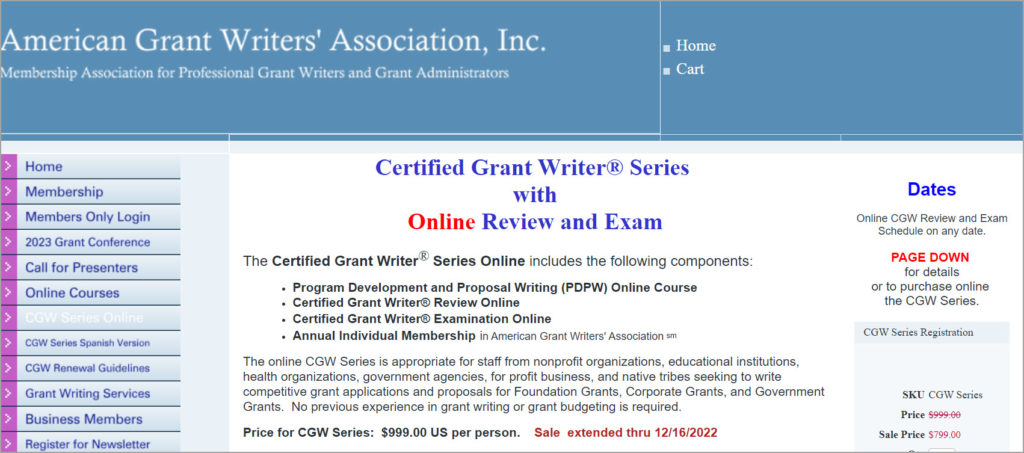
The American Grant Writers Association’s Certified Grant Writer Series is built like a structured pathway: coursework, assignments, review, and then an exam. It’s designed for professionals across nonprofits, government, health, education, and even for-profit environments.
I like the way this program drip-feeds work. You complete one section at a time and only then move forward. That structure can be annoying if you want to binge content, but it’s great if you need accountability and skill sequencing.
The curriculum hits key areas that matter in the real world, including program development, researching grant opportunities, foundation and corporate proposals, government grant applications, ethics, and budget narratives. That’s a legitimate spread.
I picked this because it’s one of the more “process-based” options. If you learn best through structured assignments and you want a credential with an exam component, this is a strong path.
Pros
Cons
LEARN MORE ABOUT AGWA Certified Grant Writer Series
Check out AGWA on their website: Certified Grant Writer Series
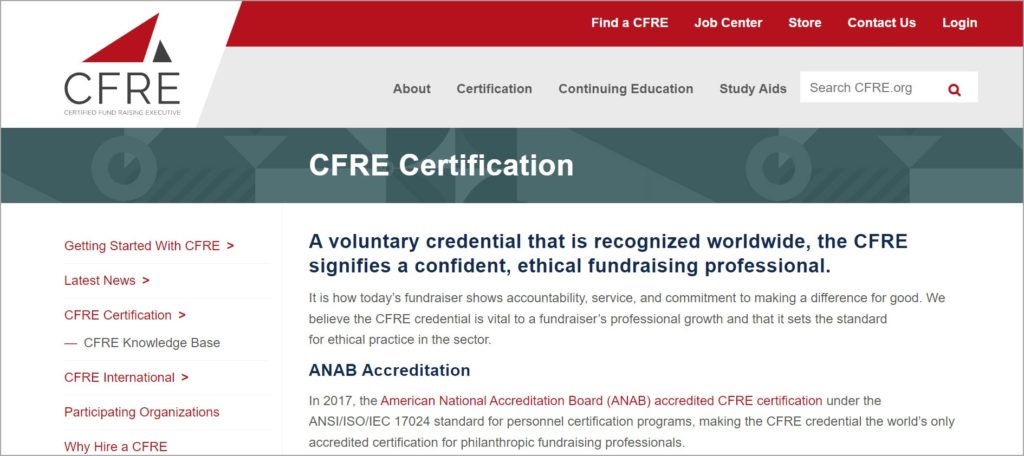
CFRE is a fundraising credential, not a grant writing credential, but it’s still relevant depending on your career direction. If you’re aiming for leadership roles in development, advancement, or fundraising operations, CFRE can carry serious weight.
The exam and application are structured around a point system and professional practice. It covers donor research, securing gifts, relationship building, leadership and management, and ethics. In other words, it’s about the full fundraising function, not just writing proposals.
So if your grant writing goals sit inside a larger fundraising career, CFRE can strengthen your credibility. If your goal is purely “write better grants,” this might be overkill.
I picked CFRE because grant writing rarely lives alone in an organization. In many nonprofits, grant writers are deeply tied to fundraising strategy and relationship management. If you want to move up, this credential can support that path.
Pros
Cons
LEARN MORE ABOUT CFRE
Check out CFRE on their website: Certified Fund Raising Executive (CFRE)
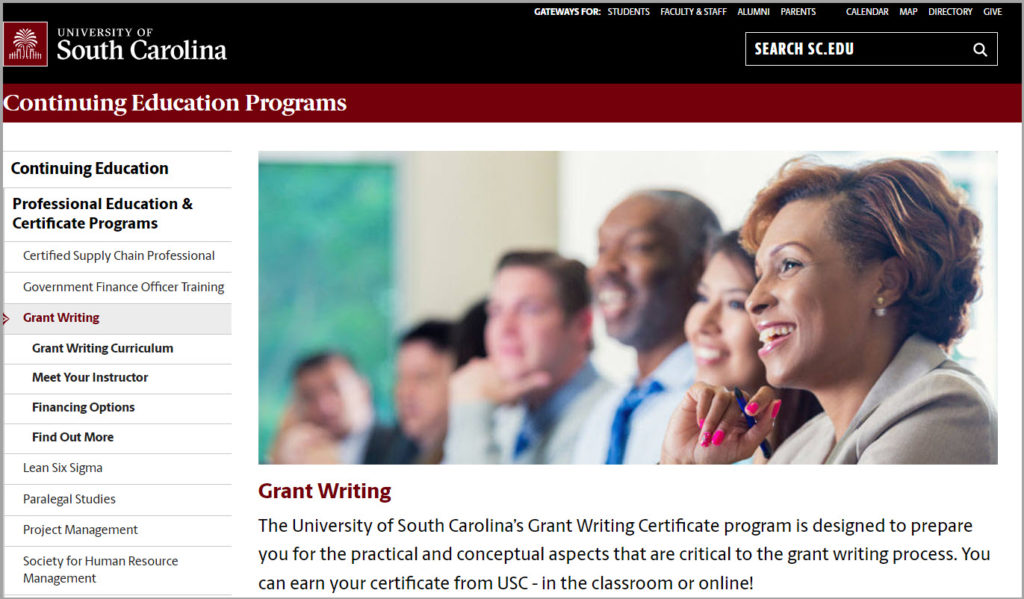
If you want something that feels like a reputable university program, USC’s Grant Writing Certificate is the most “academic program option” in this lineup. It’s designed to prepare you for the conceptual and practical aspects of the grant process, and it’s available online or on campus.
The curriculum is what I’d want from a university certificate: intro to grant writing, needs-based assessment, program development and evaluation, and the broader grant writing process. That sequence matters because it teaches you to build proposals from real needs and measurable programs, not just clever writing.
It also includes peer and professional review opportunities, which is one of the biggest advantages academic programs can offer. Feedback plus structured curriculum is a strong combo.
I picked USC because it covers what many short courses skip: needs assessment methodology and program development. If you want to write grants that survive reviewer scrutiny, those foundations matter.
Pros
Cons
LEARN MORE ABOUT USC Grant Writing Certificate
Check out USC on their website: University of South Carolina
If you’re specifically looking for a traditional academic path, here’s the pattern I’ve seen work best.
Start with a relevant bachelor’s degree that builds writing skill and domain credibility. Then add a grant writing certificate program (like USC) or an industry credential (like GPC) once you have real context. This gives you both academic background and specialized proof.
If you’re already working in a sector, the “academic option” I like most is a targeted certificate program that matches your field of interest. For example, public administration or nonprofit management programs often include fundraising and organizational strategy content that maps directly to grant work, even if the word “grant” isn’t in the degree title.
A writing degree can help, but it’s not a magic ticket.
Degrees like English, communications, journalism, or creative writing build narrative structure, concise writing, and effective communication. Those skills show up in every grant proposal. You’re still persuading a reviewer, and you still need clarity under constraints.
The limitation is that writing degrees don’t usually teach the mechanics of grant writing: budgets, funders’ requirements, the grant cycle, post-award management, and evaluation language. That’s why I like pairing a writing-focused degree with a grant writing certification course or certificate program.
If you want the shortest path to “hireable,” I’d rather you have one strong writing degree plus one credible grant credential than a random collection of unrelated courses.
This is the part most people overlook: the “best” degree depends on what you want to write grants for.
If you want to work in social services, social work or public administration can give you the vocabulary and program framing reviewers expect. If you want to work in education, an education background helps you write with the right outcomes, metrics, and program logic. If you want to write for environmental conservation, environmental studies can help you understand funder priorities and regulatory context.
Here’s the simple way I think about alignment:
Your degree signals domain fluency. Your certification signals grant-specific competence. Together, they’re a strong pairing.
If you’re exploring grant writing as a career track, these will help you tighten your plan:
Here is my criteria in choosing degrees and certifications:
I prioritize programs that teach you how to produce a full grant proposal, including the narrative, attachments, and the logic that holds it together. If a program only teaches theory, it won’t help you when a deadline hits.
Feedback is the fastest path to competence. It’s hard to self-evaluate your own proposal writing when you don’t yet know what reviewers care about. Programs with professional review, instructor critique, or structured evaluation win here.
If your goal is career leverage, a credential should be recognizable to employers or clients. Professional association credentials typically signal higher rigor. University certificate programs can signal credibility, especially to institutions and government agencies.
I look for alignment with the field you want to work in. A fundraising credential might be perfect for development leadership, while a grant-writing-specific certification is better if your goal is proposal writing work.
This sounds obvious, but it matters. A rigid program is great, unless you have a full-time job and family obligations. I always evaluate learning format, time commitment, and whether the structure fits your actual life.
Here’s how I would choose the best path:
If you already have a strong writing background, focus your education on sector knowledge and grant mechanics. If you have domain knowledge but weak writing, prioritize a writing-heavy degree or training plus a grant certificate.
Foundation and corporate grants often reward persuasive narrative and outcomes framing. Federal grants tend to reward compliance, structure, and tight evaluation logic. Your education should match the grant environment you’re targeting.
If you’re freelancing, a portfolio and references can matter more than letters after your name. If you want leadership positions or institutional roles, credentials can reduce perceived risk for hiring managers.
No matter what program you choose, create artifacts. Save drafts, keep final versions, and document improvements. Your degree helps you get in the door. Your portfolio helps you get hired.
If you don’t have grant experience yet, a certification course is often the fastest bridge. It gives you structure, language, and a plausible story in interviews while you build real reps through volunteering or entry-level roles.
Grant writing combines persuasive writing, program design, and strategic alignment with funder priorities. While there is no single degree dedicated to grant writing, pairing a relevant academic background with a targeted certification is one of the most effective ways to build skills and credibility in this field.
Your path should align with your career goals. Whether you aim to work in nonprofits, education, healthcare, or another sector, choosing a degree or certification that matches your target area ensures you gain the right expertise. Certifications like GPC or CFRE can further enhance your credibility, especially for leadership roles.
By combining education with hands-on practice and a strong portfolio, you can position yourself as a confident, capable grant writer. Use the insights in this guide to chart your path and start building the skills that lead to funding success.
Here I answer the most frequently asked questions about grant writing degrees and certifications.
Not always, but a degree often helps with credibility, especially for full-time roles. Employers tend to look for proof you can research, write clearly, and follow structured requirements. A strong certification plus a portfolio can offset the lack of a degree.
There isn’t one “best,” but common strong degrees include English, communications, public administration, nonprofit management, and social work. I’d pick based on your sector. Writing-heavy degrees help with narrative structure, while domain degrees help with funders’ requirements.
They solve different problems. A writing degree builds broad writing skills and an academic background. A grant writing certificate teaches the mechanics of proposals, budgets, and the grant cycle. If you can, pair both. If you have to choose, pick the one that fills your biggest gap.
They can be, if they match your career goals. GPC is grant-professional focused and can help signal expertise. CFRE is a fundraising leadership-oriented credential and is better suited if you’re moving into development leadership rather than pure proposal writing.
If you want structured learning, feedback, and a reputable university environment, an academic certificate program can be a good fit. If you want speed, flexibility, and practical skills you can apply immediately, a self-paced certification course is often the fastest move.
Build a portfolio while you learn. Take one course or program, produce one strong sample grant proposal, and then use that sample to get real reps through volunteer projects or part-time work. Your ROI comes from funded proposals and hired roles, not from completion badges.
Get the weekly newsletter keeping 23,000+ technical writers in the loop.
Learn grant writing and advance your career.
Please check your email for a confirmation message shortly.




















Get our #1 industry rated weekly technical writing reads newsletter.
Your syllabus has been sent to your email