
Our reviewers evaluate writing courses independently. Learn how we stay transparent, our methodology, and tell us about anything we missed.

Our reviewers evaluate writing courses independently. Learn how we stay transparent, our methodology, and tell us about anything we missed.
Business writing looks easy until your email gets ignored or your proposal falls flat. If I wanted sharper clarity, stronger persuasion, and real workplace credibility, these are the business writing courses I’d personally consider.
Here’s my pick of the 7 best courses from the lineup reviewed.
I’ve written thousands of proposals, documentation sets, and executive decks across my career. Early on, I thought being “a good writer” was enough. It wasn’t. Writing in business is about audience analysis, tone control, persuasion, and clarity under pressure.
Over the years, I’ve had to present complex growth strategies to founders, write software documentation for engineers, and create stakeholder decks that secured funding. Business writing is its own skill. It’s closer to strategy than English class.
So I reviewed these courses through one lens: if I needed to sharpen my professional communication today, which ones would actually move the needle?
Business writing courses vary wildly. Some focus on grammar. Others dive into persuasive communication, briefing decks, and stakeholder messaging. I looked at course content, instructor credibility, support systems, and real outcomes.
Here’s how each one stacks up.
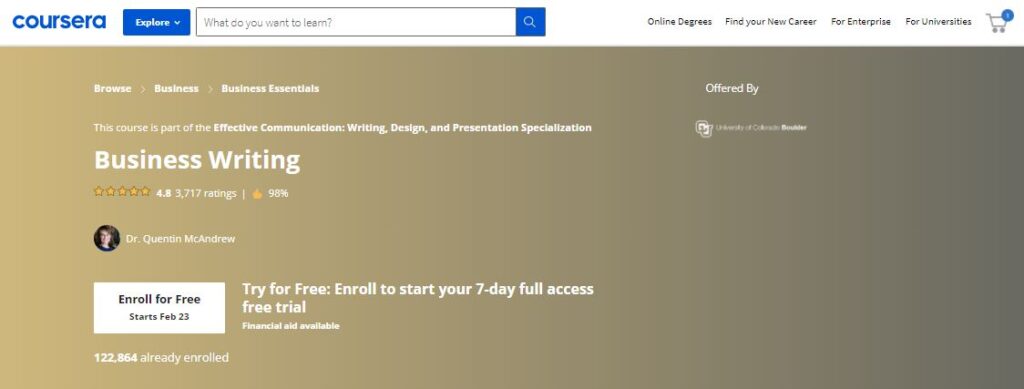
Coursera hosts business writing programs from universities like the University of Colorado and UC Irvine. These courses typically cover structure, tone, persuasive writing, and communication strategy.
Many programs go deeper than grammar. They include audience analysis, objective narrowing, evidence building, and message tone adjustment for different stakeholders. That matters if you’re presenting to executives one day and cross-functional teams the next.
The format is flexible. Most are self-paced online courses with graded assignments and peer discussions. Some offer full certificate programs that count toward professional development hours.
I picked Coursera because it blends credibility with structure. If you want something that looks strong on a resume or LinkedIn profile, university branding helps.
It also tends to include more rigorous assignments. You are not just watching video lessons. You are writing, editing, and getting feedback.
Pros
Cons
LEARN MORE ABOUT Coursera
Check out Coursera on their website: Coursera Business Writing Courses

LinkedIn Learning is built for professionals who need fast, practical skill upgrades. Their business writing tracks focus on clarity, conciseness, executive summaries, and communication tone.
You will find modules on writing to explain versus writing to persuade. There are also practical courses on presentation planning, reading decks, and structuring report decks for leadership.
Most courses are short and modular. That makes them ideal if you want to improve your delivery this week, not six months from now.
I picked LinkedIn Learning because of convenience. When I was running my agency and writing proposals daily, I needed quick improvements, not semester-long commitments.
It is also great for professionals who want to show continuous learning directly on their LinkedIn profile.
Pros
Cons
LEARN MORE ABOUT LinkedIn Learning
Check out LinkedIn Learning on their website: LinkedIn Learning Business Writing
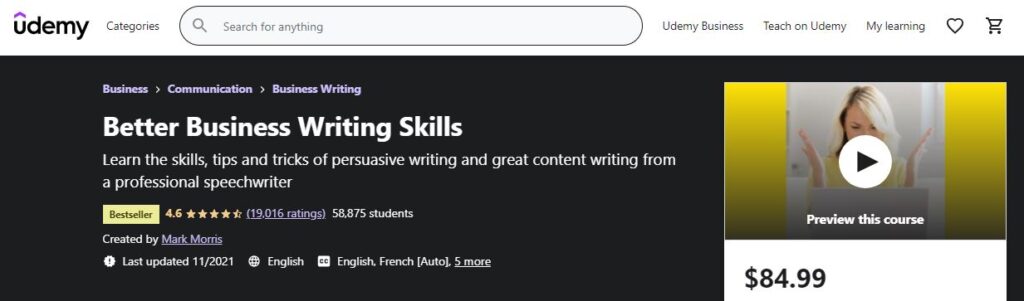
Udemy offers hundreds of business writing courses at different levels. Some focus on Business English grammar rules, others on persuasive communication or policy communications.
Because instructors vary, quality varies. But there are strong options that cover effective communication, proofreading, planning for impact, and editing.
Most courses are fully self-paced with lifetime access. That is appealing if you want affordable, flexible learning without deadlines.
I picked Udemy for affordability. If you are experimenting or just want to strengthen a specific writing weakness, it is low risk.
It is also useful for targeted skills. For example, if you only want help with proofreading or business usage rules, you can find highly specific modules.
Pros
Cons
LEARN MORE ABOUT Udemy
Check out Udemy on their website: Udemy Business Writing Courses
Harvard Business School Online offers structured programs designed for leaders and managers. These courses go beyond grammar and focus on persuasive communication, stakeholder support, and clarity in strategic messaging.
You will explore writing to persuade, evidence building, and presenting complex information with visual integrity. It is less about commas and more about influence.
Programs are cohort-based with deadlines. That adds accountability and group discussions with industry peers.
I picked this for credibility and depth. If you are aiming for senior leadership or consulting roles, the branding carries weight.
It also emphasizes communication purpose and objective narrowing, which are critical skills in executive writing.
Pros
Cons
LEARN MORE ABOUT Harvard Business School Online
Check out Harvard Business School Online on their website: Harvard Business School Online
edX partners with universities to offer structured online business writing programs. Topics often include psychology of writing, structure of information, and stakeholder communication.
These courses focus on clarity, tone, and building persuasive communication backed by visual evidence and data visualization.
Most programs include graded assignments, readings, and tests. Some offer professional certificates.
I picked edX for those who prefer academic rigor without attending in-person classes. It is structured but flexible.
It also integrates communication of quantitative data, which is a huge skill gap for many professionals.
Pros
Cons
LEARN MORE ABOUT edX
Check out edX on their website: edX Business Writing Programs

UC Irvine Extension offers a structured certificate program in business writing. It is designed for professionals who want in-demand skills and a formal credential.
Courses cover audience analysis, writing to explain, writing to persuade, editing, proofreading, and executive summaries.
The program includes experienced tutors and structured assignments with detailed feedback.
I picked this for professionals who want a clear progression path. It feels like a professional development roadmap.
If you are transitioning careers or strengthening your credentials, structured certificate programs like this help.
Pros
Cons
LEARN MORE ABOUT UC Irvine Extension
Check out UC Irvine Extension on their website: University of California Irvine Extension

Skillshare offers creative-focused business writing classes. These often blend storytelling with professional communication.
You will find modules on tone, clarity in messaging, structure, and persuasive communication. Some courses integrate AI tools for editing and planning.
It is subscription-based and highly flexible.
I picked Skillshare for creatives who want to strengthen business communication without losing voice.
If you come from marketing, design, or content creation, this platform feels less corporate and more practical.
Pros
Cons
LEARN MORE ABOUT Skillshare
Check out Skillshare on their website: Skillshare Business Writing Classes
If you are strengthening business writing, you might also find these helpful:
When I evaluate business writing courses, I do not just look at branding. I look at whether the course will actually improve real-world communication. I have written more than a thousand proposals in my career and built companies around writing, so I know what actually moves the needle.
Here is what I specifically evaluate.
I want instructors who have written for executives, stakeholders, or real organizations. Teaching grammar is one thing. Teaching how to structure a persuasive briefing deck for leadership is another.
Courses led by real-world experts tend to emphasize communication purpose, objective narrowing, and tone adjustment for different audiences. That is far more valuable than generic writing advice.
Video lessons alone do not improve writing. You improve by writing, editing, and rewriting.
I look for graded assignments, course projects, or individualized writing exercises. Platforms like Coursera and edX often include peer reviews or structured tests. Instructor-led programs may offer detailed feedback, which accelerates growth dramatically.
Not all courses are built for the same learner.
Some are ideal for beginners who need help with business English grammar rules and basic structure. Others are built for mid-career professionals refining persuasive writing and stakeholder communication. Executive programs focus on complex information presentation and evidence building.
Before recommending a course, I always ask: Who is this really for?
If the course does not clearly define its audience, that is a red flag.
This is an underrated factor.
I look at how enrollment works and what support exists after you sign up. Does the course offer:
For example, Coursera sometimes offers a Coursera Coach feature, while structured university programs include experienced tutors and detailed feedback on assignments.
Support determines how much you actually grow.
If career advancement is your goal, credentials matter.
Certificate programs, professional development hours, and graduation certificates can strengthen your resume or LinkedIn profile. For professionals transitioning roles, this can be a strategic move.
If you are only improving internal communication, formal credentials may not be necessary.
Some professionals thrive in self-paced online courses. Others need deadlines, tests, and live sessions to stay accountable.
I evaluate whether the course offers:
Flexibility matters, especially if you are balancing a full-time job.
Choosing the right course is less about picking the “best” one and more about picking the right one for you.
Here is how I recommend approaching it.
Be honest about your writing weaknesses.
Do you struggle with clarity in messaging? Are your emails too long? Do your presentations lack persuasive communication? Are you unsure how to structure an executive summary?
If grammar is your main issue, choose a fundamentals-heavy course. If persuasion and stakeholder support are your goals, prioritize programs that emphasize writing to persuade and evidence building.
Business writing is context-specific.
If you work in finance or operations, you may need help presenting quantitative data and visual evidence. If you are in marketing or product, tone and storytelling may matter more.
If you are in a leadership role, focus on courses that teach:
Your industry and role should guide your choice.
Self-paced lessons are flexible and ideal for busy professionals. You can watch video lessons at night and complete assignments on weekends.
Cohort-based programs include live sessions, facilitated discussions, and deadlines. They create accountability and exposure to industry peers.
If you need structure, choose cohort-based. If you need flexibility, choose self-paced with lifetime access.
Feedback accelerates improvement.
Look for courses that offer:
Writing improves through iteration. If the course lacks feedback mechanisms, you will need to be disciplined about self-editing.
Enrollment should be straightforward.
Review:
If you want long-term reference material, ensure the platform offers lifetime access rather than limited-time subscriptions.
The best course is one you apply immediately.
Choose a program that aligns with your daily writing tasks. If you write proposals, pick a course heavy on persuasive communication. If you prepare presentations, prioritize presentation skills and report deck structuring.
Here I answer the most frequently asked questions about business writing courses.
In my experience, yes. Clear communication improves stakeholder support, confidence, and career progression.
If you regularly write emails, reports, briefing decks, or proposals, small improvements in clarity and structure compound over time. One well-structured executive summary can influence decisions at a high level.
Self-paced courses allow you to complete video lessons, readings, and assignments on your schedule. They often include lifetime access.
Instructor-led courses follow a schedule with live sessions, facilitated discussions, and deadlines. They may include more detailed feedback and stronger accountability.
If you struggle with consistency, instructor-led programs can be more effective.
It depends on the platform.
University-backed programs often include graded assignments and peer reviews. Some offer instructor access and detailed feedback. Subscription platforms may rely more on discussion forums.
If personalized feedback is important to you, confirm this before enrolling.
Yes, especially those covering report decks, visual integrity, and complex information presentation.
Many courses include modules on structuring reading decks, integrating graphic elements, and aligning message tone with audience expectations. These skills directly enhance presentation delivery.
If you actively apply what you learn, improvement can happen within weeks.
Writing improves through repetition. Complete assignments, revise your own emails using course frameworks, and practice editing for conciseness and clarity. The more you apply it, the faster you improve.
Before enrolling, review:
Do not enroll just because the branding is strong. Ensure the format, support, and content align with your professional goals.
Not always.
If your goal is internal improvement, skill development alone is enough. However, if you are transitioning roles, seeking promotion, or building credibility in a new industry, a certificate program can strengthen your positioning.
Treat the course like a project, not passive content.
Participate in discussion forums. Complete all graded assignments. Rewrite real work documents using course frameworks. Seek feedback when available. Apply the principles to your daily communication immediately.
Get the weekly newsletter keeping 23,000+ technical writers in the loop.
Learn grant writing and advance your career.
Please check your email for a confirmation message shortly.





















Get our #1 industry rated weekly technical writing reads newsletter.
Your syllabus has been sent to your email