Our reviewers evaluate career pieces independently. Learn how we stay transparent, our methodology, and tell us about anything we missed.

Our reviewers evaluate career pieces independently. Learn how we stay transparent, our methodology, and tell us about anything we missed.
If you’ve ever read a “content strategist job description” and thought, cool, but what do they do all day, you’re not alone.
I’ve worked with content strategists who basically ran the entire digital experience without anyone noticing (until things broke). I’ve also seen teams hire “a content strategist” when what they really wanted was a copywriter, a social media manager, and a project manager rolled into one human. That mismatch is where a lot of confusion comes from.
Before we jump in, a quick “why you should listen to me” moment. I’ve spent years building and optimizing content-heavy websites and product experiences. Early in my career, I was writing software documentation for a video editing company, which forced me to learn how real users think, what they ignore, and what they actually need to complete a task. That’s content strategy in disguise.
Okay, no more rambling.
At the simplest level, a content strategist makes sure content is intentional.
Not “we should post more on LinkedIn” intentional. I mean: the right content, for the right audience, at the right time, in the right format, with a clear reason it exists.
Depending on the company, “content strategist” can mean a few different things:
Here’s how I explain the role to hiring teams: a content strategist connects the dots between business goals, audience needs, and the reality of content production.
They’re not just writing. They’re not just planning. They’re creating the system and decision-making framework that keeps content from becoming a chaotic pile of “random stuff we published last year.”
If you want the shortest definition I can give you, it’s this:
A content strategist is responsible for planning, shaping, and improving content so it performs, scales, and stays consistent across channels.
And yes, that includes the unglamorous parts like governance, stakeholder buy-in, and untangling conflicting opinions about tone of voice (fun times).
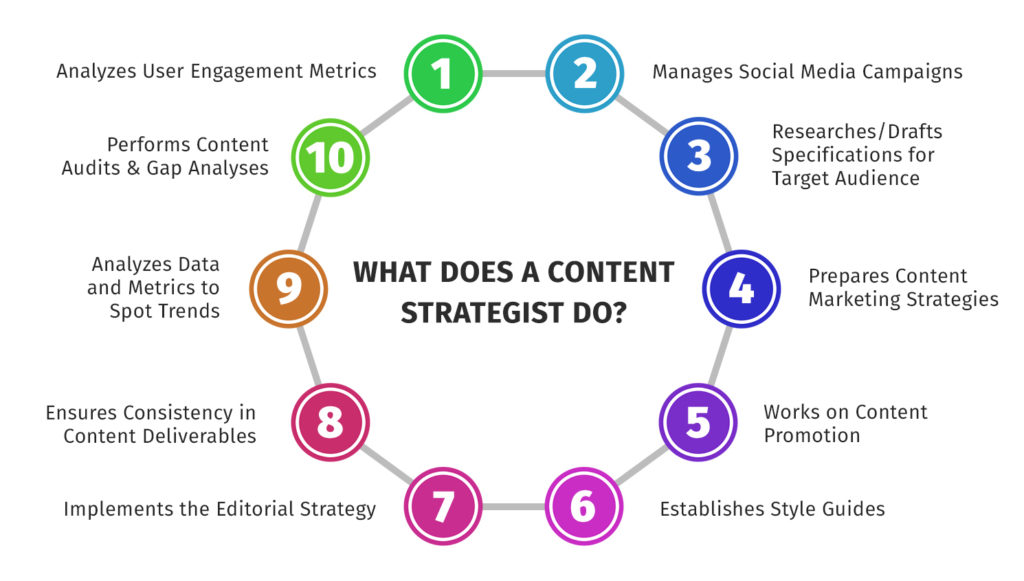
Content strategy looks different depending on whether you’re in a marketing org, a product org, or a blended team. But in most roles, the responsibilities cluster into a few repeatable buckets: research, planning, governance, execution enablement, and performance analysis.
Here are the duties I see most often:
A content strategist typically builds (or improves) audience personas and maps content to real user intent. That might mean stakeholder interviews, customer interviews, support ticket mining, usability observations, or analytics review. The goal is to stop guessing.
A lot of “bad content” is just content written for an imaginary audience.
This is one of the most practical responsibilities in the role. A strategist inventories what exists, evaluates performance, identifies duplication, flags outdated content, and finds missing pieces. From there, they recommend what to keep, update, merge, redirect, or delete.
If you’ve never done a content audit, it’s basically spring cleaning, but for a website that has been “temporarily” adding pages since 2017.
Strong strategists do customer journey mapping and content mapping so the content experience matches how buyers and users actually move through the funnel (or through the product). This is where cross-channel complexity shows up: website, email, sales enablement, social, product UI, help center, and sometimes even in-app messages.
When content feels disjointed, it’s usually because no one has mapped the end-to-end journey.
This is the part people skip until it hurts.
Content strategists often own content governance, which includes editorial guidelines, tone of voice frameworks, accessibility considerations, and “who approves what” rules. They also help define taxonomies and metadata strategies so content is findable and reusable.
If you’ve ever watched a company rebrand and then realize they have 600 blog posts using the old terminology, you already understand why governance matters.
Strategists maintain editorial calendars, coordinate cross-functional projects, and manage content requirements across teams. In practice, this looks like negotiating deadlines, reducing context switching, and setting up workflows that prevent last-minute fire drills.
A good content strategist is often the calmest person in the room when everyone else is panicking that “we need it live by Friday.”
For marketing-heavy roles, keyword research and topic planning are core. That includes topic clustering, information hierarchy planning, and aligning content priorities to business outcomes. It also includes defining what “success” means before writing begins (traffic is nice, but it’s not the whole story).
Finally, content strategists monitor content performance, run competitive content audits, and recommend improvements based on ROI, usability, and conversion data. This is where the role becomes less about opinion and more about evidence.
If you’re trying to understand the skill set that supports these responsibilities, my guide on essential content strategist skills pairs well with this section.
The fastest way to spot a strong content strategist is how they think. The second fastest way is how they communicate that thinking to other people.
Here’s the competency stack I’d focus on.
Content strategy is mostly prioritization. You’re deciding what content matters, what doesn’t, what needs updating, and what should never have existed in the first place (politely, of course).
This requires planning skills, roadmapping instincts, and the ability to say “not yet” without getting steamrolled by stakeholder demands.
Content strategists need analytical skills, but not necessarily “data scientist” skills.
You should be comfortable with:
The role gets much easier when you can point to evidence instead of debating taste.
SEO is still a core skill for many strategist roles, especially marketing-aligned jobs. But it’s not “sprinkle keywords into headings” SEO. It’s understanding search intent, topic clustering, internal linking logic, and how content supports website development over time.
And even if your role is UX-focused, you still need channel awareness. Cross-channel content governance matters because users experience your brand across multiple touchpoints, whether you planned it or not.
Even when strategists aren’t the primary content creator, they need strong writing fundamentals. If you can’t write clearly, it’s hard to set a standard for other writers.
This includes copywriting fundamentals, editorial structure, and being able to give feedback that improves the content without rewriting everything yourself.
Content strategy is deeply cross-functional. You’ll collaborate with designers, product, engineering, sales, and marketing professionals. And you’ll need leadership skills even when you’re not a manager, because governance changes require behavior changes.
Change management is a real skill here. You’re often trying to shift how people plan, create, approve, and maintain content. That’s never just a “process update.” It’s politics, incentives, and habit loops.
This sounds basic, but it’s make-or-break.
Between stakeholder interviews, audits, planning, project updates, and performance reporting, content strategy is a context switching job. Strong organization, task management, and ruthless clarity around “what matters this week” are what keep you from drowning.
There isn’t one perfect degree for content strategy, which is honestly part of why the field is so interesting.
I’ve met excellent content strategists with backgrounds in journalism, marketing, UX design, library science, technical writing, and program management. The common thread is not the university degree. It’s the ability to understand users, shape information, and execute through complexity.
That said, many job listings still prefer a bachelor’s degree in marketing, communications, English, or a related field. If you have one, great. If you don’t, you’ll want to compensate with proof: experience, a portfolio, and evidence you can run cross-functional projects.
If I were breaking into content strategy today, I’d focus on three entry routes:
A lot of strategists start as content creators, writers, editors, or copywriters, then expand into planning and governance. If you’re already writing, start owning the “why” and “what next,” not just the deliverable.
A content strategy portfolio can include content audits, content gap analyses, customer journey mapping samples, taxonomy work, or a content requirements matrix. The format matters less than the thinking.
Volunteer for the messy projects other people avoid: content cleanup, navigation rework, CMS migrations, guideline creation, and analytics review. Those projects build the exact skill set hiring managers want.
If you want a step-by-step breakdown, I laid out a full roadmap on how to become a content strategist without experience. It’s the same advice I give friends who are trying to pivot without starting from zero.
Tools won’t make you strategic, but the right toolkit reduces friction and helps you scale.
Here are the categories that show up in content strategist workflows.
You don’t need to be a developer, but you do need to understand how content is structured, published, and maintained. A CMS shapes what’s possible, and it shapes how easy it is to keep content consistent.
Common CMS-related skills include content modeling, basic governance rules, and working with templates.
A content strategist lives in measurement.
Whether it’s web analytics, product analytics, or email performance dashboards, you should be comfortable pulling insights and turning them into recommendations.
A practical tip: don’t just report metrics. Tie them to decisions. “Traffic went up” is trivia. “Traffic went up because we addressed a gap and improved internal linking” is strategy.
Many strategists use an SEO tool (or several) for keyword research, competitive analysis, and content gap work. The tool choice changes by team and budget, but the underlying skill is the same: understand intent, organize topics, and prioritize content based on impact.
In mature orgs, you’ll see content operations platforms, editorial calendar tools, and structured workflows for reviews and approvals. In smaller orgs, this might just be a spreadsheet template and a shared doc system.
The point is to reduce chaos and make content production predictable.
Some of the most valuable “tools” are boring: content audit spreadsheet templates, content requirements matrices, content mapping docs, sitemaps, and taxonomy spreadsheets. These create shared clarity across teams.
If you can build these templates and keep them maintained, you’ll look like a wizard.
In more UX-adjacent roles, you’ll often reference plain language and usability best practices. Even if you never link to the resources, having those standards in your head helps you create guidelines that improve content quality across the board.
I’m not saying this to scare you off, but content strategy can be a deceptively hard job.
On the surface, it looks like planning and writing. In reality, it’s navigating ambiguity, stakeholder pressure, and shifting algorithms while trying to prove ROI with imperfect data.
Here are the challenges I see most often.
Content strategy changes how people work. That means you need buy-in from stakeholders who may not care about governance, usability, or accessibility until something breaks.
You’ll spend a lot of time persuading people that consistency matters, that content needs ownership, and that “just publish it” is not a plan.
Content ROI is real, but it’s rarely clean.
Attribution is messy. Cross-channel complexity makes it harder. And some content outcomes are indirect, like reduced support volume, improved usability, or better onboarding completion.
A strong strategist gets comfortable with imperfect measurement and still makes decisions with confidence.
Governance isn’t a doc you write once. It’s a living system.
You’ll be updating guidelines, refining workflows, managing exceptions, and fixing what happens when people ignore the rules because they’re in a hurry.
This is a big one.
Content strategists often sit at the center of multiple projects, which creates constant context switching: audits, planning, stakeholder interviews, approvals, performance reviews, urgent fixes. If you don’t protect your time, your work becomes reactive.
Accessibility is no longer optional. In many orgs, it’s a requirement, and content plays a huge role in whether experiences are usable. Strategists get pulled into accessibility blockers, content clarity issues, and usability reviews, especially for content-heavy flows.
The upside is that this work makes you more valuable. The downside is that it adds another layer of responsibility you have to plan for.
One reason content strategy is a great career is that it has multiple “next steps,” depending on what you enjoy.
Most content strategist career progression looks like some version of:
Along the way, many strategists pick areas of specialization. Common ones include SEO strategy, UX content strategy, content operations, governance, or industry specialization (healthcare, fintech, developer tools, etc.).
Promotion usually happens when you move from “I can execute strategy” to “I can scale strategy.” That means:
If you’re curious what that management layer looks like, my breakdown of what a content strategy manager does is a good companion read. It’ll help you see what skills you’d need to level up into a senior role.
One more thing: some people progress laterally into adjacent roles like marketing, professional leadership, UX leadership, or program management, especially if they’re strong at cross-functional planning.
Content strategist compensation varies a lot because the title is used across different types of roles.
In the U.S., most salary datasets cluster around a mid five-figure to low six-figure base for many content strategist roles, with higher pay in tech-heavy industries and for senior job levels. Remote roles can pay competitively, but the range is wider, and “content strategist” can sometimes mean “do everything content-related,” which affects market rates.
Contract rates also vary. Some strategists go freelance after a few years and charge day rates or monthly retainers, especially if they specialize in audits, governance, or SEO strategy.
If you want to sanity-check current salary range data, I typically tell people to compare a couple aggregators like PayScale’s content strategist salary data (US) and Glassdoor’s content strategist salary estimates (US). You’ll see slightly different numbers, but the overlap gives you a reasonable starting band.
The job outlook piece is less about “is content strategy growing” and more about “what kind of content strategy.” I’m seeing more demand for:
If you can tie content to outcomes, you’ll stay employable.
Content strategy is one of those fields where community helps a lot, especially early on.
If you’re trying to break in or level up, I’d focus on a few community types:
A long-running staple is The Content Strategy Podcast, which is great for hearing how experienced strategists think through governance, collaboration, and process maturity. Podcasts are low-effort learning you can stack on top of your day without burning out.
Conferences are hit-or-miss, but the good ones give you two things: shared language and real peers. Content strategy-specific events (and adjacent content ops or UX conferences) can be useful if you’re trying to grow your network or find mentors.
Slack communities, LinkedIn groups, and community-building spaces for marketers and content folks can be surprisingly valuable, especially if you show up consistently and give thoughtful feedback.
The trick is to avoid joining 12 communities and participating in none. Pick one or two, be helpful, and build relationship management over time. That’s what turns “networking” into real professional development.
Webinars are useful for staying current without paying conference prices. Panel discussions are also great because you’ll hear multiple perspectives on the same problem, which is basically the content strategy job in miniature.
If you’re new to content strategy, here’s what I’d focus on.
First, stop trying to memorize job titles. Content strategist job titles are messy. Focus on your skill set: research, planning, governance, measurement, and cross-functional execution.
Second, practice the work in small, concrete projects:
Third, learn how to communicate your thinking.
In interviews and stakeholder meetings, content strategists win by explaining tradeoffs. “Here’s what I’d do and why” beats “here are my opinions” every time.
Finally, get comfortable with governance.
Most people avoid content governance because it’s not flashy. But if you can build a governance system that a team actually follows, you become incredibly valuable. That’s how you move toward senior role territory faster than you’d expect.
And if you’re prepping for interviews, it helps to rehearse how you talk through your process. My list of content strategist interview questions can help you practice answers that sound like a working strategist, not a job description.
Here are answers to some of the most common questions I hear about content strategy careers.
Not exactly. Content marketing is often campaign-focused and acquisition-focused. Content strategy is broader: it includes planning, governance, structure, and long-term content systems across channels.
A degree can help, especially in marketing or communications, but it’s not the only path. A strong portfolio, cross-functional project experience, and proof you can plan and improve content systems can outweigh formal education.
Copywriters primarily write persuasive copy. Content strategists plan, structure, govern, and measure content across channels. Some roles overlap, but strategy work includes systems and decision-making, not just execution.
Great portfolios show thinking: audits, gap analyses, journey maps, governance docs, editorial calendars, content models, and before/after improvements with reasoning. Writing samples help, but process is the differentiator.
They connect content work to outcomes: conversions, leads, onboarding completion, reduced support volume, improved usability signals, and performance trends over time. ROI is rarely one metric, so they build a measurement story.
Yes. Many roles are remote or hybrid, and freelancing is common after you’ve built a track record. Specializing in audits, governance, or SEO strategy can make freelance work more predictable.
If you are new to Content Strategy writing and are looking to break into the industry, we recommend taking our Technical Writing Certification Course, where you will learn the fundamentals of writing and managing technical documentation.
Learn UX writing and advance your career.
Your syllabus has been sent to your email