
Our reviewers evaluate career opinion pieces independently. Learn how we stay transparent, our methodology, and tell us about anything we missed.

Our reviewers evaluate career opinion pieces independently. Learn how we stay transparent, our methodology, and tell us about anything we missed.
After building a lot of websites and running conversion tests, I got deep into UX writing alongside technical writing. UX copy is the stuff that decides whether someone succeeds in a product or rage-clicks “Cancel.” Different craft, same mission: clarity.
So, I’m going to walk you through how these roles show up inside companies, what they write day-to-day, how careers and salaries usually evolve, and how I’d choose between them in a real hiring situation. Starting… now!
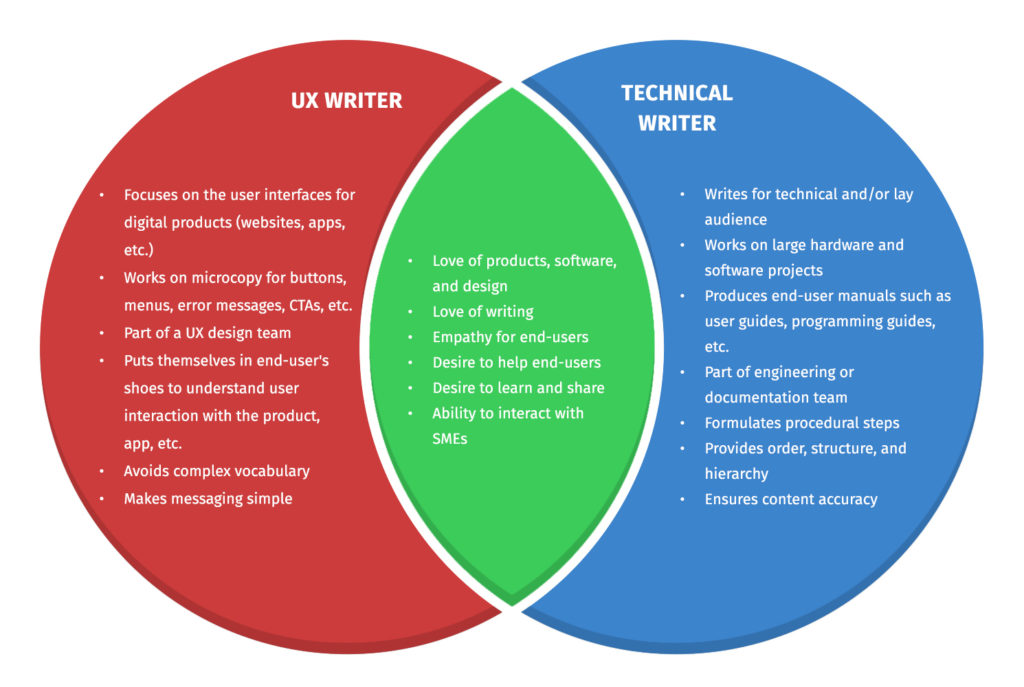
Image Credit: Keith Mahoney
Before we get into the details, here’s the simplest way I think about it: A UX writer helps the user succeed without leaving the interface. A technical writer helps the user succeed once they need deeper explanations, reference, or step-by-step guidance.
A lot of confusion happens because both roles “write for users.” True. But they write for different moments in the user journey and they collaborate with different teams to get the work shipped.
Two things can be true at once:
You can fix (1) with a UX writer. You can fix (2) with a technical writer. If you try to force one role to do both, you usually end up with “fine” UI text and “okay” docs, but nothing feels intentional.
If you’re brand new to these job titles, I’d start by reading what a UX writer actually does. Then come back here.
Here’s how I draw the line in the real world:
A UX writer owns the words inside the product experience. That includes:
UX writing is user-centered writing, but it’s also product writing. You’re working from the user’s point of view while still serving business goals, usability objectives, and brand voice.
A technical writer owns the structured knowledge around the product. That includes:
Technical writing is less about persuasion and more about accuracy, completeness, and information architecture. You’re creating durable reference materials that multiple teams rely on, not just end users.
If you want the clean definition version, check out my guide on what a technical writer does.
Here’s the overlap that matters: both roles exist to reduce confusion. Both UX writers and technical writers:
But the distinction that matters is where the confusion is happening.
UX writing is front-end experience writing. It lives inside the digital interface. If the microcopy is wrong, the user can’t even start. That’s why UX writers obsess over tiny changes like “Create account” vs “Continue,” and why they care about onboarding and user journeys so much.
Technical writing is the safety net. It lives outside the immediate UI moment, and it has to work even when the user is stressed, blocked, or troubleshooting.
If you want a broader primer (especially if you’re moving from marketing writing into product writing), here’s my take on UX writing basics.
Let’s make this practical. A UX writer’s typical day looks like:
If you’ve ever seen a confusing error message that says something like “Invalid input,” that’s a UX writing problem. The better version is specific, human, and actionable. It tells the user what happened and what to do next.
A technical writer’s typical day looks like:
If you want a strong technical-writing workflow to copy, here’s how I approach writing software documentation step-by-step.
This is the part nobody tells you when you’re job hunting. UX writers usually sit close to design teams or product teams. Their work is deeply tied to:
In some orgs, UX writers report into design. In others, they’re grouped under content strategy, content design, or “product content.”
Technical writers often sit in engineering-adjacent teams, documentation-driven environments, or centralized technical communications groups. Their work touches:
At scale, this becomes a systems game. If you want the “big picture” view, here’s what product documentation really looks like inside a company.
Learn and master UX writing skills with our beginner-friendly detailed UX writing course:

Let’s talk skills in a way that’s useful in interviews. UX writer skills that actually matter:
If you’re skill-building intentionally, start with my guide on UX writer skills.
Technical writer skills that actually matter:
If you want the checklist version, here are the technical writing skills I see come up again and again.
Career trajectories are where these roles start to feel very different. A common UX writing path looks like:
If you want a structured breakdown, read my guide on the UX writer career path.
A common technical writing path looks like:
If you want the full ladder, here’s the technical writer career path.
Now salary. Technical writing has better public salary data because it’s a long-established role category. If you want a clean official benchmark, the BLS page is the best place to start (It’s the one I trust most for a reality check).
UX writer salary data is messier because titles vary (UX writer, content designer, product content strategist), and compensation swings widely based on company, location, and seniority. In practice, UX writer compensation can get very competitive in product-led orgs, especially when you’re embedded with UX researchers, design teams, and high-impact product squads.
Also, cash bonuses are real in both lanes. They tend to show up more in larger orgs and become more meaningful as you move into senior and lead roles.
If you’re an organization hiring, here’s my rule of thumb. Hire a UX writer when:
And hire a technical writer when:
If you’re choosing a career direction for yourself, I’d ask one question: Do I want to live in the product interface, or in the knowledge system around the product?
If you want to break into UX writing from scratch, here’s my guide on how to become a UX writer.
If you remember nothing else from this comparison, remember this: UX writing helps users succeed in the moment. Technical writing helps users succeed when the moment gets complicated.
The best product experiences usually have both, even if it’s one person wearing two hats early on. If you’re hiring, map the confusion to the user journey and staff the role that fixes the biggest pain first. If you’re choosing a career path, pick the work you want to do every day, because both roles can be lucrative, respected, and genuinely fun if you’re in the right environment.
If you’re building samples, portfolios matter in both roles. Here are UX-specific examples: UX writer portfolio examples.
And if you’re leaning technical, use this as your benchmark: technical writing portfolio examples.
Here I answer frequently asked questions about UX and technical writers.
Yes, especially in smaller companies. But it’s hard to do both well at the same time because the work rhythms differ. UX writing is sprint-based and design-file heavy. Technical writing is system-based and maintenance-heavy. If one person does both, you need clear priorities.
In most product orgs, yes. You don’t need to be a designer, but you should be comfortable working in design files, leaving comments, and understanding component-based UI patterns.
Not always. But technical writers who understand basic developer workflows (APIs, version control, release cycles) often ramp faster and collaborate more smoothly with engineering teams.
UX writers think about in-the-moment guidance and behavior inside the interface. Technical writers think about durable understanding, completeness, and information architecture across a doc set.
On onboarding and support experiences. UX writers create the in-app guidance and microcopy. Technical writers create the deeper help content, tutorials, and reference materials users rely on when they need more than a tooltip.
It depends on your background. If you already have strong long-form writing, research skills, and comfort with technical topics, technical writing can be more straightforward to enter. If you’re design-adjacent, love short-form writing, and can build a microcopy-focused portfolio, UX writing can be a great fit too.
Get the weekly newsletter keeping 23,000+ technical writers in the loop.
Learn UX writing and advance your career.
Please check your email for a confirmation message shortly.





















Get our #1 industry rated weekly technical writing reads newsletter.
Your syllabus has been sent to your email