Our reviewers evaluate career opinion pieces independently. Learn how we stay transparent, our methodology, and tell us about anything we missed.

Our reviewers evaluate career opinion pieces independently. Learn how we stay transparent, our methodology, and tell us about anything we missed.
When I’m skimming technical writer resumes (or talking to hiring managers who are), I hear the same silent questions:
That’s why the best resumes focus less on “I wrote documentation” and more on what kind of documentation, for who, in what environment, and what changed because of it.
If you want the job posting side of this equation, read the companion guide on a technical writer job description so your resume mirrors what employers list.
I also have a video where I go over a technical writer resume if you want to check it out.

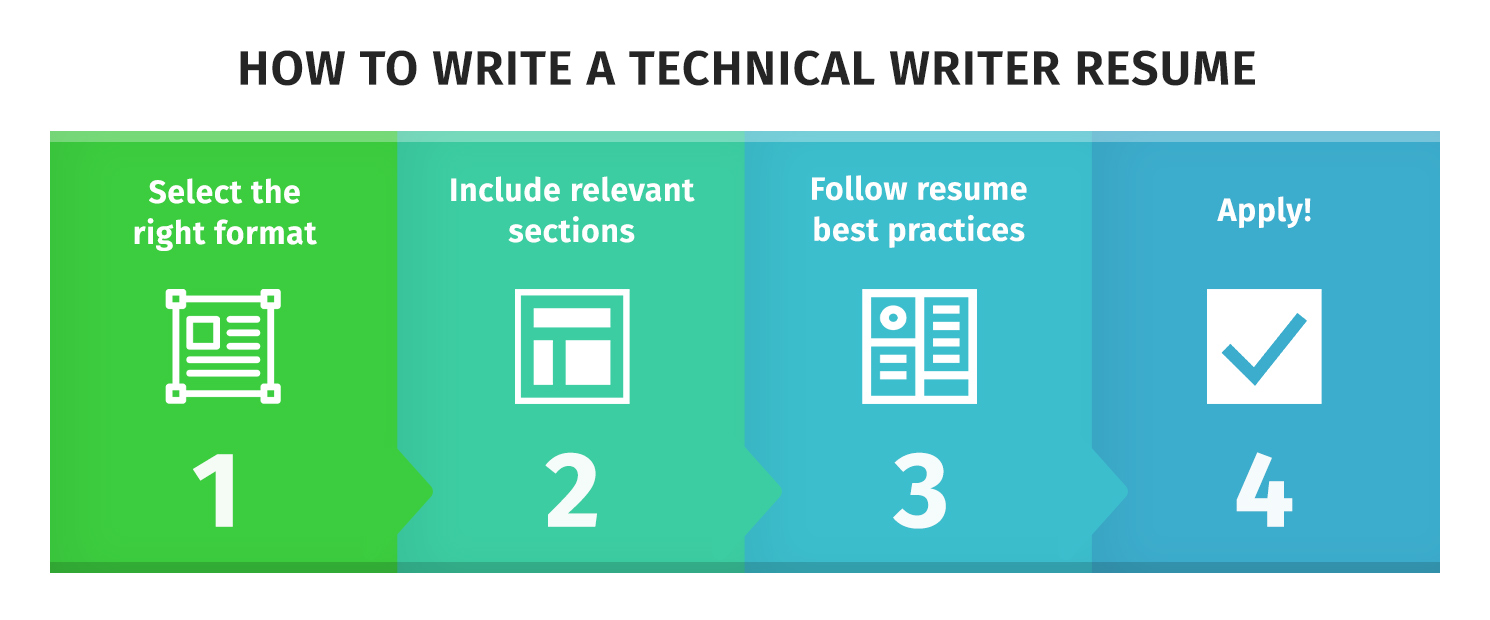
Here’s a detailed step-by-step on writing a resume.
Put your name, email, location (city + state/country is enough), and LinkedIn at the top. Then add the most important line on the whole resume: your portfolio link.
Why is the portfolio link so critical? It acts as proof of your skills, giving hiring managers a direct way to see how you think, write, and structure documentation. A strong portfolio complements your resume by showing outcomes instead of just listing tasks. To make an impact, ensure your portfolio link is easy to access and leads to a clean, professional layout that highlights your best work.
If you don’t have one yet, build it. Here’s my guide on creating a technical writing portfolio in 2026.
Your professional summary is the “preview text” of your resume. If it’s vague, the rest of the page has to work harder. A good summary is short, specific, and role-aligned. I like 3–4 sentences that cover:
Here’s a template you can adapt:
“I’m a technical writer with X years of experience creating [doc types] for [audience]. I work closely with subject matter experts across engineering, product, and support to ship clear, user-friendly documentation that stays current through releases. Comfortable with [tools/workflows], and known for [strength: clarity, editing, information architecture, speed + accuracy]. Recent work includes [one measurable win or high-signal project].”
If you’re newer, don’t pretend you’re senior. Aim to sound confident and specific.
Your skills section is partly for humans and partly for ATS scanning. The trick is listing skills that actually show up in technical writer job postings. I like grouping skills so it reads cleanly without looking like a keyword wall.
Think: documentation tools, authoring environments, and workflows.
Content management systems, docs-as-code workflows, version control, information architecture, topic-based authoring, editing and proofreading, diagramming/screenshot tools, and (for some roles) basic html/css or scripting exposure.
If you’re applying to roles that touch discoverability, it’s fair to include SEO content creation, but only if you’ve done it in a documentation context (help centers, public docs, knowledge bases).
I know “soft skills” gets eye-rolls, but technical writing is collaboration-heavy. These skills matter because they impact your ability to navigate real-world workflows and produce effective documentation:
This is where most resumes either win or quietly die. Hiring managers expect you to write documentation. What they want to know is whether you can ship it in real conditions.
Start with the basics: job title, company, location (or remote), and start/end dates. Then write 2–5 bullets (or short lines) that show scope and impact. If you prefer paragraphs, that works too, as long as it’s skimmable.
Mention the documentation types you produced (software user guides, end-user manuals, knowledge base articles, SOPs, process documentation, release notes). Mention who you partnered with (SMEs, engineers, product). Mention the workflow (review cycles, version control, CMS). Then add one or two outcomes.
Outcomes can be measured (“reduced repeat support tickets by X%”) or directional (“reduced repeat questions by improving onboarding docs and restructuring navigation”). Even if you don’t have perfect metrics, show the result.
“Owned documentation for a suite of cloud-based applications, including onboarding guides, feature docs, and release notes. Partnered with SMEs across engineering and support to gather requirements, validate edge cases, and ship updates on a release cadence. Improved doc findability by restructuring navigation and creating standardized templates, reducing repeat questions from support.”
Notice what that does: it tells me you can operate inside a product team, not just write.
If you’re preparing for interviews, it helps to align the stories on your resume with what you’ll be asked live. This guide on technical writer interview questions is a nice companion.
Your education section should be clean and factual. List the title of your degree, college or university, graduation date (or expected graduation date). That’s it.
If you have relevant coursework (technical writing, communications, journalism, scientific subjects, software development), you can add one short line, but only if it helps your candidacy. Don’t turn this into a transcript.
If you don’t have a degree, don’t panic. Many teams will care more about your portfolio and work history. If you want a broader view of how employers think about credentials, read technical writer education requirements.
Certifications can help, but only when they do one of these things:
If you’re early-career, a techwriter certification or a structured certification program can help if it results in portfolio-ready work. The key is not the badge, it’s the proof it produces.
If you’re moving toward content strategy or information architecture, certifications or courses in content strategy, information design, UX writing, or structured authoring can support that narrative.
If you’re working in regulated spaces, industry-related certifications (or training tied to compliance-heavy documentation) can be valuable because it signals you can handle higher-stakes content.
And yes, if you’ve done SEO content creation for documentation sites, including a relevant credential can help. Just make sure your experience also shows you used it in practice (help center findability, doc IA, search intent).
If you have 1–3 strong certifications, place them in a dedicated “Certifications” section near the top half of your resume (especially if you’re career-changing).
If certifications are secondary, keep them below experience and skills.
Before you send your resume anywhere, do one last pass like you’re editing a user guide. Check consistency in:
This is where a lot of candidates accidentally fail the “attention to detail” test before the interview even starts.
Here’s an example of a technical writer’s resume that I find almost perfect.
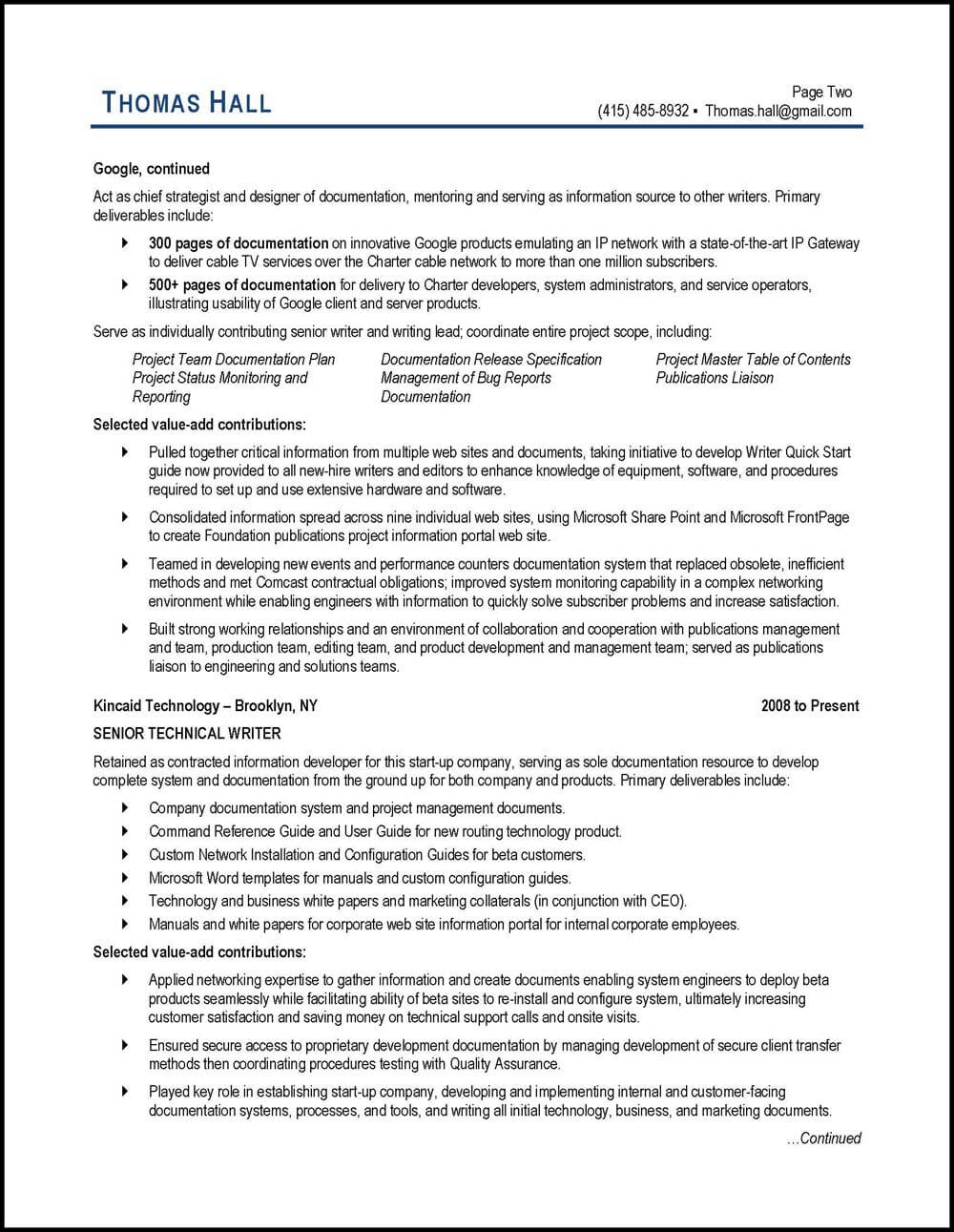
Every line says how they can make an impact. They also avoid using an objective, job summary, separate skills section, and irrelevant experience. The only improvements I’d make here is breaking up the paragraphs into shorter bullet points and limiting the resume to one page.
They also mastered including their skills, software knowledge, and any other relevant experience in their job descriptions. They don’t just list SharePoint under a “Skills” section. They write, “Consolidated information across nine individual websites, using Microsoft SharePoint…” That’s how it’s done.
If you’re in the “I don’t have experience yet” bucket, don’t wait. Build samples now and treat them like real documentation. This guide on how to become a technical writer without experience pairs well with the portfolio approach.
Your technical writer resume is more than a job history; it’s a one-page case for why you’re the right fit for the role. Focus on clarity, outcomes, and relevance to show hiring managers you can deliver effective documentation in real-world conditions.
Tailor your resume to the job description, include a strong portfolio link, and highlight both technical and collaboration skills. Treat your resume as a living document, updating it with new achievements and skills as you grow. A strong, focused resume can help you confidently move toward the opportunities you want.
Here I answer the most frequently asked questions about creating a technical writer’s resume.
A strong professional summary should quickly state your role level, the doc types you write, the audiences you write for, and one proof point. Keep it short and specific. Avoid generic filler.
Yes, if they strengthen your story. Professional certifications, industry-related certifications, and tool/workflow training can help, especially for career-changers. But certifications work best when they’re paired with a portfolio and real writing samples.
Focus on hard skills (documentation tools, CMS, docs-as-code, editing, information architecture) and soft skills that matter in the job (communication with SMEs, time management, attention to detail). Match skills to the job description language.
Use skimmable entries that show doc types, audiences, collaboration, tools/workflows, and outcomes. Hiring managers want proof you can ship documentation in real-world conditions, not just a list of tasks.
Many job posts list a bachelor’s degree, often in writing-heavy or technical fields. But in practice, a strong portfolio and relevant experience can matter more than the major, especially in software documentation roles.
Get the weekly newsletter keeping 23,000+ technical writers in the loop.
Learn technical writing and advance your career.
Please check your email for a confirmation message shortly.




















Get our #1 industry rated weekly technical writing reads newsletter.
Your syllabus has been sent to your email