
Our reviewers evaluate writing courses independently. Learn how we stay transparent, our methodology, and tell us about anything we missed.

Our reviewers evaluate writing courses independently. Learn how we stay transparent, our methodology, and tell us about anything we missed.
The first time I had to write “serious business writing” for a real job, I overcomplicated everything. My emails were too long, my reports read like school papers, and my tone changed every other paragraph because I was trying to sound “professional.”
Over time, I learned business writing is mostly about clarity and decisions. What does the reader need, what do I want them to do next, and what’s the fastest way to get there without sounding like a robot.
If you want to level up fast, a good online class helps. Below are the courses I’d personally look at, whether you’re trying to write sharper emails, better reports, or more persuasive proposals.
Here’s my pick of the 10 best options.
If you’re choosing a course, don’t start with the platform. Start with the writing you do weekly.
If you write a lot of emails and status updates, you want quick modules and templates. If you write reports, proposals, or longer documents, you want structure, revision practice, and feedback.
Also, decide whether you care about a credential. A certificate can help with career advancement, but only if the course actually builds job-relevant skills you can show.
Below are the classes and training options I’d recommend most often, based on different goals. I’ve included both self-paced courses and coaching-style options because “feedback” is usually what makes writing improve faster.
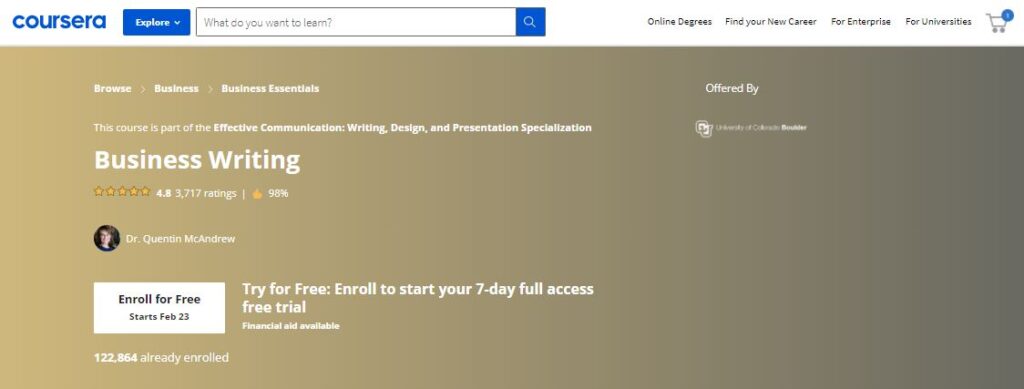
Coursera is where I go when I want a real learning path, not just a single lesson. You can find business writing courses, effective communication specializations, and professional certificates that feel “resume-safe.”
The structure is the main benefit. Courses often include videos, readings, assignments, and peer reviews, which forces you to practice instead of passively watching. That’s important because business writing improves through revision, not inspiration.
Coursera also works well if you want a credential for your LinkedIn profile. Many courses offer a shareable certificate, and that can help when you’re making a career move or trying to signal skill growth.
I picked Coursera because it consistently offers the best balance of structured learning and credibility. If your goal is career advancement plus real skill-building, this is usually the first place I’d check.
Pros
Cons
LEARN MORE ABOUT COURSERA: Check out Coursera on their website.
LinkedIn Learning is my pick when you want improvements fast. The content is usually broken into short videos, and it’s designed for busy professionals who need something practical.
This is great for specific business writing needs like email-writing skills, tone, clarity, grammar refreshers, and writing for multiple audiences. You can often take a course in an afternoon and immediately apply one or two techniques at work.
It also fits career positioning well. Completed courses show up on your LinkedIn profile, which is a simple way to signal professional development without overthinking it.
I picked LinkedIn Learning because it’s the fastest path to “better writing next week.” If your goal is clearer emails, better memos, and fewer writing pitfalls, it’s hard to beat.
Pros
Cons
LEARN MORE ABOUT LINKEDIN LEARNING: Check out LinkedIn Learning on their website.
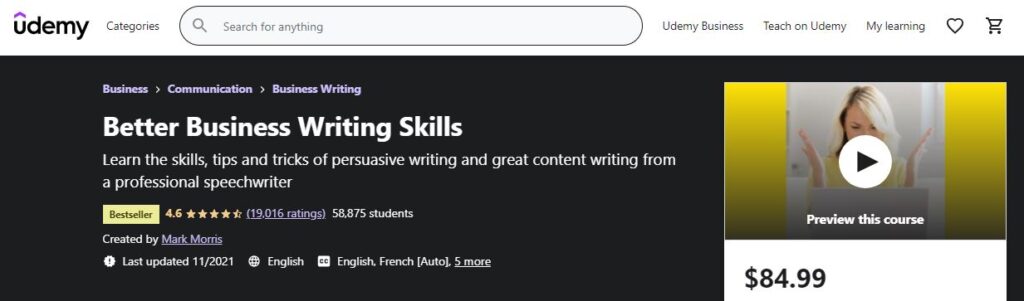
Udemy is where I go when I want a very specific skill for a low price. Think “writing effective workplace email,” “business grammar,” “executive writing,” or “writing successful business proposals.”
The best Udemy courses include templates, hands-on projects, and writing exercises you can reuse at work. The worst ones feel like someone reading slides. So on Udemy, reviews and previews matter more than the platform itself.
If you’re on a budget or you want to solve one writing pain point quickly, Udemy is a strong option. Just be picky and choose instructors with real business writing experience.
I picked Udemy because it’s the most efficient option for targeted upskilling. If you know exactly what you want to improve, you can often find a course that gets you there without a big time commitment.
Pros
Cons
LEARN MORE ABOUT UDEMY: Check out Udemy on their website.
edX is a good fit when you want a more academic structure, but still online. It’s often closer to “continuing education courses” than casual video learning.
The coursework tends to be more structured, with graded assignments, readings, and longer documents like reports. That’s helpful if you’re trying to build durable writing process strategies, not just quick hacks.
edX can also be a good choice for learners who want a recognizable credential. Depending on the course, you may be able to earn a verified certificate that feels more formal than a completion badge.
I picked edX because it’s a solid middle ground between flexibility and academic credibility. If you want structure and rigor, it’s a safer bet than most marketplaces.
Pros
Cons
LEARN MORE ABOUT EDX: Check out edX on their website.

Harvard Extension School is for people who want a serious credential and a more formal learning experience. These courses can be a great fit if you want something that clearly signals professional effort, not just curiosity.
The structure typically includes readings, assignments, and instructor-led expectations. That’s a plus if you want accountability and a final grade that reflects real work.
This option is not the cheapest or fastest. But if you’re positioning for promotion, career change, or leadership roles where writing matters, the credential and training can carry weight.
I picked Harvard Extension School because sometimes the credential is part of the goal. If you’re using business writing to support career advancement, this is one of the more recognizable options.
Pros
Cons
LEARN MORE ABOUT HARVARD EXTENSION: Check out Harvard Extension School on their website.

UC Berkeley Extension is a great option when you want practical business writing taught with academic structure. It often sits in the sweet spot between “too casual” and “too theoretical.”
You’ll typically see a focus on business documents like emails, memos, reports, and professional correspondence. The best programs emphasize organization, revision, and clear writing principles rather than just grammar rules.
If you want a credential that looks solid on a resume, extension programs can help. They signal continuing education and professional investment without requiring a full degree.
I picked UC Berkeley Extension because it’s a reliable way to build fundamentals with structure. If you want to improve across multiple business writing genres, this is a strong path.
Pros
Cons
LEARN MORE ABOUT UC BERKELEY EXTENSION: Check out UC Berkeley Extension on their website.

If you want a more guided “program” experience on Coursera, university partner tracks like the University of Colorado Boulder offerings can be a good fit. You get structured learning and a clearer progression through skills.
These programs tend to cover effective communication, tone, and writing for different audiences. They often include hands-on projects that force you to apply what you learn, which is where real improvement happens.
This is also a good path if you want a career certificate style credential without committing to a more expensive university extension format. It can be a strong middle ground for many professionals.
I picked this option because many learners want a structured specialization without a heavy time or cost burden. It’s a practical way to build job-relevant skills and show progress publicly.
Pros
Cons
LEARN MORE ABOUT CU BOULDER ON COURSERA: Check out University of Colorado Boulder on Coursera on their website.

If you’re buying for a company, you want something different. AMA-style corporate training options are built for teams, not solo learners, and they usually come with consistent delivery and facilitator-led sessions.
This is where you can run team training around email standards, report templates, and organizational formula patterns so everyone writes in a consistent way. It’s also useful for organizations with leadership teams that want writing coaching at scale.
The best corporate programs include diagnostics, practice, and follow-up. If it’s only a one-time workshop, it won’t stick.
I picked AMA because it’s designed for business outcomes, not hobby learning. If you need organizational upskilling with predictable delivery, corporate providers like this are usually a safer bet.
Pros
Cons
LEARN MORE ABOUT AMA: Check out American Management Association on their website.

Skillshare is useful when you want to practice writing without committing to a formal credential path. It’s not where I’d go for a career certificate, but it can be a helpful training ground for clarity, tone, and confidence.
You’ll find courses on writing fundamentals, editing skills, persuasion, and even business communication basics. Many are short and project-oriented, which makes it easier to stay consistent.
If you want momentum and you learn well through short videos and simple techniques, this is a good option. Just treat it as practice, not accreditation.
I picked Skillshare because consistency matters more than perfection early on. For many people, a low-pressure platform is the easiest way to build the habit of writing and revising.
Pros
Cons
LEARN MORE ABOUT SKILLSHARE: Check out Skillshare on their website.

FutureLearn is a good fit if you like guided pacing and a community feel. Courses tend to be short, structured, and designed for discussion alongside learning.
This works well for improving writing principles and avoiding common writing pitfalls. The community aspect can also keep you motivated, especially if you learn best by comparing approaches and getting peer input.
If your goal is structured learning without a heavy long-term commitment, this is worth considering. Just make sure the specific course includes assignments, not just videos.
I picked FutureLearn because some learners do better with paced learning and social reinforcement. If you need motivation and structure, community-driven platforms can help.
Pros
Cons
LEARN MORE ABOUT FUTURELEARN: Check out FutureLearn on their website.
Most business writing courses fall into a few categories. Picking the right category is half the decision.
General business writing covers clarity, tone, grammar, and structure across multiple business documents. Specialized writing courses focus on one genre, like emails, proposals, reports, or executive communication.
You’ll also find individualized business writing training and coaching. That’s typically best when you need customized feedback or you’re writing high-stakes documents that impact your professional image.
A good course usually includes short videos, examples, and assignments that mimic real workplace writing. Look for modules that cover emails, memos, reports, and revision strategies, not just grammar rules.
The strongest programs include hands-on projects and peer reviews or instructor feedback. That feedback loop matters because business writing improves through editing and rewriting, not passive watching.
If you’re taking a course for longer documents, look for scaffolding. You want a structured path from outline to draft to revision, not a “write something and hope” approach.
Most solid business writing courses focus on plain English writing skills, sentence structure, and tone for multiple audiences. They also teach you how to choose an organizational formula that makes the reader’s job easier.
If you want a practical angle, I’d focus on writing process strategies like planning, structuring, and revising. Grammar helps, but clarity and decision-making are what move your career.
If you’re also exploring technical writing, you’ll notice overlap. Business writing and technical writing both reward clarity, strong structure, and audience empathy. If you’re curious, this guide on what technical writing is gives the bigger picture.
If you want fast improvement, prioritize courses with customized feedback or coaching. AI-graded assignments can be useful for basics, but they won’t catch tone problems or unclear reasoning the same way a human can.
Look for expert instructors with real-world writing experience. In business writing, teaching style matters because you need actionable critiques, not vague encouragement.
If you’re aiming for executive writing, the best instructors focus on strategy and clarity over “sounding fancy.”
If you’re using a business writing course for career advancement, treat the certificate as a bonus, not the whole point. Hiring managers care more about whether you can write clearly than whether you watched 20 videos.
That said, a career certificate can help your resume and LinkedIn profile, especially when paired with a portfolio of improved work. I like adding a course credential and then updating my resume bullets to reflect the new skill, like “wrote executive summaries” or “standardized team email templates.”
If you want to sharpen your overall business writing credibility, it also helps to understand business writing principles and study a few strong business writing examples. Those two resources make courses feel more practical.
If you’re buying training for a company, you want consistency, adoption, and measurable outcomes. That usually means team training, shared templates, and writing standards across the organization.
Corporate programs work best when they include practice, feedback, and reinforcement. One workshop rarely changes behavior. A program that includes exercises on emails, reports, and executive writing is more likely to stick.
If your team includes executive nonnative speakers of English, individualized business writing training or coaching can be a better investment than a general course. It solves real communication friction faster.
Here’s my criteria for choosing the courses to include in my lists.
If a course doesn’t force you to write and revise, it won’t change your writing. I look for hands-on projects, peer reviews, or coaching.
I want a course that matches the writing I do: emails, reports, memos, proposals, or executive summaries. The closer the course is to your real work, the faster you’ll see improvement.
If I want a credential, I choose courses with a career certificate or recognized continuing education format. If I don’t care about the credential, I choose the most practical course regardless of brand.
Short videos help, but structure matters more. I prefer programs with clear modules, assignments, and an easy-to-follow scaffold that keeps me moving.
I look for expert instructors with real-world experience. Good business writing is less about theory and more about knowing what works in real organizations.
If 80 percent of your writing is email, choose an email-focused course. If you write reports and memos, choose something with longer document practice and revision.
If you write proposals, pick a proposal-focused option and pair it with practical frameworks. This guide on business writing can help you identify the main genres you’ll want to practice.
If you want the fastest improvement, choose a course with customized feedback or coaching. If you’re just building foundations, self-paced instruction can be enough.
A useful rule is this: if your writing affects promotions, clients, or leadership perception, feedback is worth paying for.
If you’re updating your resume or LinkedIn, choose a program with a recognized credential. Then, use what you learned to update your work examples and bullet points.
If you want help polishing that positioning, you’ll probably like these guides on business writing skills and business writing tips.
Here I answer the most frequently asked questions about online business writing classes.
Yes, if you apply what you learn. Clear writing improves your professional image, reduces misunderstandings, and makes you look more competent in leadership communication.
Certificates can help, but the real career boost is showing you can write clearly in real work.
If you need a credential for your resume, choose a certificate-focused option like Coursera, edX, or an extension program. If you mainly want skill improvement fast, self-paced platforms like LinkedIn Learning or Udemy can be enough.
I usually recommend starting self-paced, then upgrading to a credential path if you want to formalize it.
Look for a course that focuses on email-writing skills, tone, and structure. Short, job-ready courses often work best here because you can apply changes immediately.
Also, practice rewriting real emails. That is where improvement shows up.
Look for peer reviews, instructor-graded assignments, coaching, or required assessments. If it’s only videos, the feedback loop is missing.
If you want the fastest gains, pick something with customized feedback.
Yes, especially courses focused on clarity, structure, and tone. Coaching is often the fastest option if you’re writing high-stakes documents and want individualized guidance.
If you’re choosing a course, look for explicit support for writing clarity and business grammar.
Write, revise, and get feedback. Tools and courses help, but improvement comes from practicing real business documents like emails, memos, and short reports.
Get the weekly newsletter keeping 23,000+ technical writers in the loop.
Learn grant writing and advance your career.
Please check your email for a confirmation message shortly.





















Get our #1 industry rated weekly technical writing reads newsletter.
Your syllabus has been sent to your email