
Our reviewers evaluate writing services independently. Learn how we stay transparent, our methodology, and tell us about anything we missed.

Our reviewers evaluate writing services independently. Learn how we stay transparent, our methodology, and tell us about anything we missed.
The first ghostwriter I hired was for a business guide. This was way back before TWHQ. She charged something like $1,000 upfront and then missed two deadlines and delivered something that read like a Wikipedia article rewritten by someone who’d never run a company. I asked for revisions. She sent back the same draft with a few adjectives swapped out. Overall, it took more time than necessary.
Since then I’ve hired ghostwriters through Reedsy, Upwork, Fiverr, and two boutique agencies. Some were great. Most were fine. A few were disasters. The biggest thing I’ve learned: where you find the writer matters less than how you screen them and what you put in the contract.
This guide breaks down 11 platforms I’ve used or evaluated, with real pricing, what each one is actually good for, and the legal protections you need before you hand over a deposit.
Next, I’ll go in detail about each platform from my shortlist.

Reedsy only accepts about 3% of professionals who apply. Every ghostwriter on the platform has a published portfolio, verified reviews, and a track record in traditional publishing. You won’t find $500 blog posts here. This is where you go when you’re writing a book and you want someone who’s done it before.
I like Reedsy for one specific reason: you can see comparable titles. If a ghostwriter helped publish a business book through Penguin Random House, that’s on their profile. You’re not guessing whether they can handle long-form work.
The downside is cost. Book ghostwriting on Reedsy typically runs $5,000 to $50,000 or more, depending on length and complexity. For a full-length memoir or business book, expect $15,000 to $30,000 as a realistic starting range. The platform charges no fees to clients, which is unusual.
If you’re looking for someone to write business content rather than a book, a freelance technical writer might be a better fit.
Learn more: Check out Reedsy on their website.

Upwork is the biggest freelance marketplace, and it shows. You’ll find ghostwriters charging $15 an hour and others charging $150. The range is enormous because there’s no gatekeeping. Anyone can create a profile.
That said, I’ve found some of my best writers on Upwork. The trick is the Escrow system. You set milestones, fund each one in advance, and release payment only when you approve the deliverable. This protects both sides and creates natural check-in points.
For a 30,000-word book manuscript, I’ve seen quotes ranging from $3,000 on the low end to $25,000 from experienced specialists. Blog ghostwriting runs $50 to $500 per post depending on depth. The platform takes a 10% service fee from the writer’s side.
My Upwork screening process:
The trial costs $100–$200 and saves thousands in bad hires.
Learn more: Check out Upwork on their website.
Fiverr works well for short ghostwriting projects. Blog posts, LinkedIn content, product descriptions, short ebooks. I wouldn’t use it for a 200-page manuscript, but for a 2,000-word article or a series of social media posts, the speed and pricing are hard to beat.
Most ghostwriting gigs on Fiverr fall between $50 and $500. You can filter by delivery time, revision count, and seller level. Fiverr Pro adds a vetting layer if you’re willing to pay more for pre-screened talent.
One thing to watch: revision limits. Many Fiverr sellers cap revisions at two or three rounds. If your project needs back-and-forth, negotiate that upfront or use a platform with more flexibility.
Learn more: Check out Fiverr on their website.
Freelancer uses a bidding model. You post your project and writers submit proposals with their rates. It’s useful for getting a quick read on market pricing, but the quality spread is even wider than Upwork.
I’ve used Freelancer for smaller ghostwriting tasks where I needed three or four proposals fast. The milestone payment system works, but the vetting burden falls entirely on you. There’s no curation, no screening. You’re sorting through dozens of bids, many of which are templates.
Rates typically run $10 to $60 per hour. For fixed-price projects, expect $200 to $5,000 depending on scope.
Learn more: Check out Freelancer on their website.

WriterAccess sits between a marketplace and a managed service. Writers are rated on a 2-star to 6-star scale, and you can filter by industry, content type, and quality tier. The platform includes workflow tools for assigning, reviewing, and approving content.
This works best for teams producing multiple ghostwritten pieces at once. If you’re a content strategist running a blog or thought leadership program, the built-in project management helps.
Pricing is subscription-based. Plans start around $99 per month for access to the writer pool. Individual piece rates vary by writer level, typically $0.04 to $0.20 per word.
Learn more: Check out WriterAccess on their website.

Scripted focuses on recurring content rather than one-off projects. Their subscription model ($149/mo and up) includes access to a curated writer pool, and they handle the matching process for you.
It’s a good fit for businesses that need consistent ghostwritten blog posts, newsletters, or LinkedIn articles. Not ideal for book projects or one-time needs. The strength is the system, not any individual writer.
Learn more: Check out Scripted on their website.

The Urban Writers packages ghostwriting with editing and formatting. You’re buying a bundled service, not hiring a single freelancer. Packages for ebooks and short books typically run $1,000 to $8,000.
The trade-off is control. You don’t always pick your writer, and the revision process is more structured. For indie authors who want a finished manuscript without managing the project themselves, it works. For founders who want to be deeply involved in the voice and direction, it can feel limiting.
Learn more: Check out The Urban Writers on their website.

This is a premium agency. They run a full interview process, assign a writer matched to your topic, and provide editorial oversight throughout. Pricing starts around $15,000 for a short book and can exceed $60,000 for complex projects.
I’d consider Ghostwriter Inside for high-stakes projects where the book is tied to your business, your fundraising, or your personal brand. The cost is real, but so is the support structure. They handle interviews, outlines, drafts, and revisions on a fixed timeline.
Learn more: Check out Ghostwriter Inside on their website.

Scribe Media built its reputation on executive and business book ghostwriting. Their process is interview-driven: a team of editors and writers conducts deep sessions with you, then drafts the manuscript based on your ideas and stories.
Pricing ranges from $25,000 to over $100,000 depending on the package. The most expensive tiers include publishing guidance, positioning strategy, and launch support. This isn’t a writing service. It’s a book-as-a-business-asset service.
For founders who see a book as part of their authority strategy, Scribe makes sense. If you just need a proposal writer or a business plan, it’s overkill.
Learn more: Check out Scribe Media on their website.

Guru is a proposal-based marketplace, similar to Freelancer but with a slightly more structured contract system. Writers outline their approach, timeline, and revision terms before you commit.
I’ve found it useful for mid-range projects where I want to compare multiple approaches side by side. Hourly rates typically run $20 to $80. The talent pool is smaller than Upwork’s, so you’ll see fewer proposals, but the quality tends to be more consistent.
Learn more: Check out Guru on their website.

Toptal screens applicants and claims to accept only the top 3%. The vetting includes language tests, writing samples, and a live interview. If you’re tired of sifting through hundreds of portfolios, this approach saves time.
The trade-off is price. Rates typically start at $60 per hour and go up to $200+ for specialists. Toptal is built more for tech and business talent than creative writing, but they do have ghostwriters who specialize in business books, whitepapers, and executive content.
Learn more: Check out Toptal on their website.
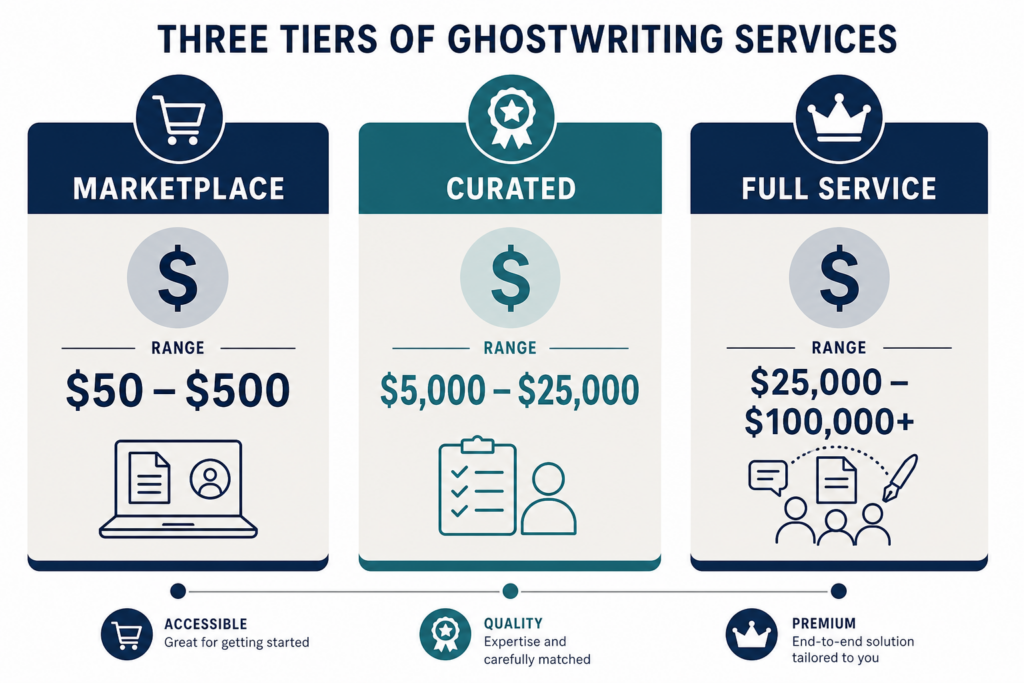
Ghostwriting rates vary dramatically by platform type and project scope. Always compare per-project, not just per-word rates.
Ghostwriting is a legal agreement as much as a creative one. I’ve seen writers retain partial copyright, reuse client content in their portfolios, and even list themselves as co-authors on published books. All of this happens because the contract wasn’t clear enough.
Three things your contract needs:
Work-for-hire clause. This transfers all rights to you upon payment. Without it, the ghostwriter may retain some copyright under U.S. law. This isn’t theoretical. It happens.
Non-disclosure agreement. Especially for business books, memoirs, or anything involving proprietary information. A standard NDA covers the content, your identity as the client, and any business details shared during the project.
Revision and termination terms. Define how many revision rounds are included, what counts as a “revision” vs. a rewrite, and what happens if either side wants to walk away. If you’re working on a business proposal or a book manuscript, these details prevent expensive disputes later.
Ghostwriting pricing falls into three tiers, and the tier depends on the platform type more than the individual writer.
Open marketplaces (Upwork, Fiverr, Freelancer, Guru) price per word, per hour, or per project. You negotiate directly. A 50,000-word book manuscript on Upwork might cost $3,000 from a newer writer or $25,000 from a specialist. Blog posts run $50 to $500.
Curated platforms (Reedsy, WriterAccess, Toptal) charge more because they handle part of the vetting. Book projects on Reedsy start around $5,000. Toptal rates start at $60/hr. WriterAccess charges $0.04–$0.20 per word on top of a subscription fee.
Full-service agencies (Scribe Media, Ghostwriter Inside, The Urban Writers) set package prices. You’re paying for a process, not just a writer. Expect $1,000 to $8,000 for packaged ebook services, $15,000 to $60,000+ for full book manuscripts, and $25,000 to $100,000+ for executive book programs.
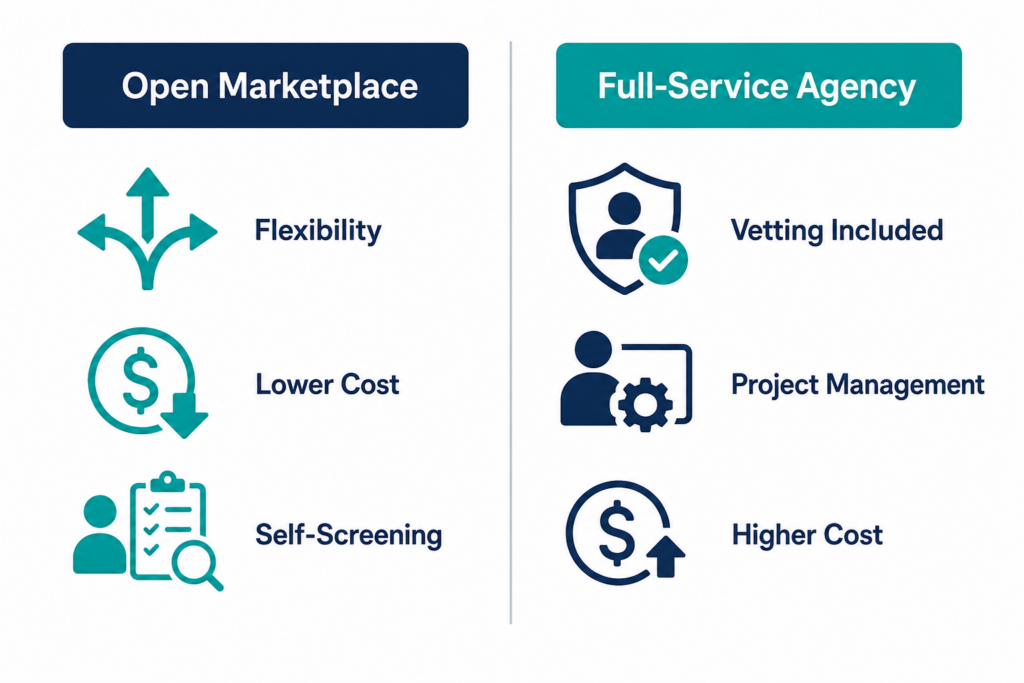
Marketplace vs. curated vs. full-service: the price difference reflects the screening and support structure, not just writing quality.
Run a paid trial before committing to anything over $1,000. A 1,000-word sample on your actual topic costs $100–$200 and tells you more than any portfolio.
Ask for references, then actually call them. I skipped this step twice and regretted it both times. A five-minute call with a previous client reveals things that reviews don’t. The same applies if you’re hiring a speech writer or a whitepaper writer. Always check references.
Define your voice before the project starts. Record yourself talking about the topic for 20 minutes, transcribe it, and send it to the ghostwriter. This gives them something real to work from instead of guessing your tone.
Put everything in the contract. Deadlines, revision rounds, kill fees, NDA terms, copyright transfer. If it’s not in writing, it doesn’t exist.
Here I answer the most frequently asked questions about hiring a ghostwriter.
Most professional ghostwriters operate under strict contracts and NDAs. Trustworthiness increases when you use structured agreements and secure payment systems.
Always review contracts carefully and clarify ownership of content.
Freelance ghostwriters offer flexibility and often lower pricing. Agencies provide more structure, oversight, and sometimes full-service publishing support.
Your choice depends on budget, risk tolerance, and project complexity.
Yes. Many platforms support global hiring. Make sure you account for time zones, language precision, and communication expectations.
Clear milestone scheduling reduces friction across time zones.
Most platforms use escrow or milestone systems. Premium agencies may require deposits and staged payments.
Always avoid large upfront payments without defined deliverables.
In most professional ghostwriting agreements, you retain full rights under a work-for-hire contract.
Make sure ownership and copyrights are clearly stated in the contract before work begins.
Get the weekly newsletter keeping 23,000+ technical writers in the loop.
Learn technical writing and advance your career.
Please check your email for a confirmation message shortly.





















Get our #1 industry rated weekly technical writing reads newsletter.
Your syllabus has been sent to your email